Untitled Art's announcement for its fifteenth Miami Beach edition, December 2 to 6, 2026, names photography as one of the fair's strongest throughlines, from the canonical figures who changed postwar image-making to younger artists working on identity, ecology and digital culture. The list is good: Joana Choumali with albertz benda, Hoda Afshar with Danziger Gallery, Fabiola Menchelli with Marshall Gallery, Alison Rossiter with Yossi Milo. What the press release does not say, and what the list says on its own, is that two of the four most interesting names on it have spent years refusing the camera.
That is the argument worth carrying onto the sand. A short walk from these booths, the fair's Special Projects sector is showing Gabo Arora's The Great Dictator, an AI installation that inserts visitors into archival political speeches. It is a reasonable thing to show in 2026. It is also the clearest possible backdrop for work that answers the opposite question: not how convincingly an image can be faked, but what a photograph is once you take the picture out of it.
Rossiter: the archive as a darkroom
Rossiter, born in Jackson, Mississippi, in 1953, works from a library of expired photographic paper. Alina Cohen, writing in Artsy in April, traces the turn to 2007, when the artist developed a sheet of Kodabromide E3 with a use-by date of 1946 and saw what decades on a shelf had done to it. "The results were so startling that I began a relentless search for old photographic papers to see what time had done to these light-sensitive materials," Rossiter told Artsy. She now collects and processes paper from every decade of the twentieth century; her titles record both dates, when the paper expired and when she developed it.
Her fourth solo show with Yossi Milo, Semblance, ran in New York from January 15 to March 21, 2026. It paired anonymous, failed daguerreotype plates from the mid-nineteenth century with sheets of late-nineteenth-century Velox paper, in honour, the gallery quotes her, of Louis Daguerre and Leo Baekeland: the first invention gave photography to the world, the second handed it to the amateur. It also debuted Semblance, Man Ray Tapestry, grids of gaslight papers from the 1910s and 1920s built with Man Ray's 1911 sewn textile in mind. Many of the sheets show silver mirroring, the slow tarnish that turns old emulsion into a foggy, reflective surface. "When I hold one of these prints," Rossiter says in the gallery's text, "it's like I'm time traveling to the 1920s."
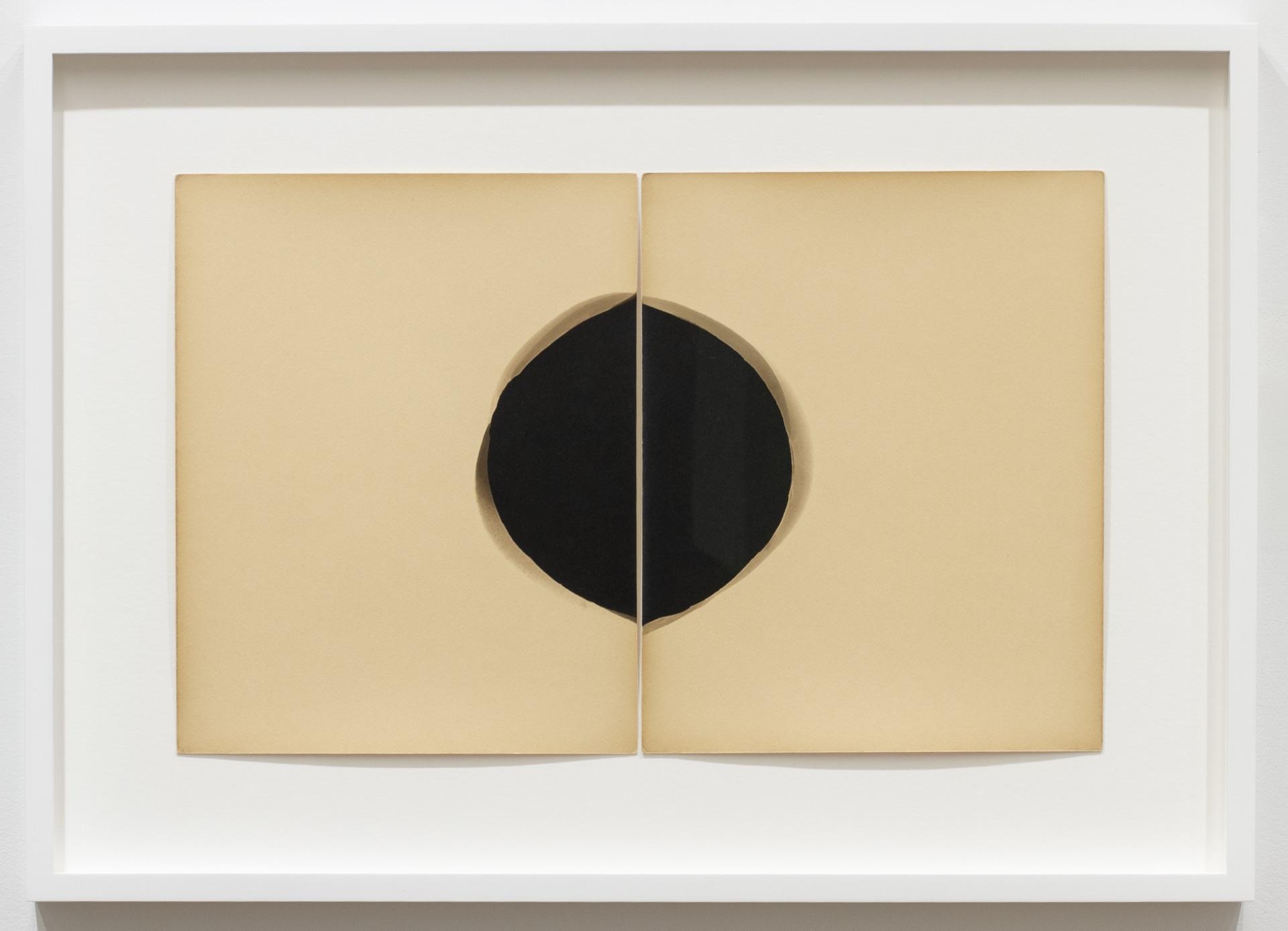
The image above is the clearest statement of the method. Two sheets of Eastman Kodak Portrait Bromide, expired in June 1937, processed in 2025, butted together so that a single dark form spans the seam. Rossiter has controlled where the developer goes. She has not controlled what eighty-eight years did to the paper's edges and tone. The work is the negotiation between the two, and it looks nothing like an image of something. It is a record of a duration.
Menchelli: folding the light
Fabiola Menchelli, who lives and works in Mexico City, arrives at a similar place from the opposite direction. Where Rossiter accepts the exposure time has already made, Menchelli makes colour photograms in the darkroom, exposing the paper to light through a range of colour filters and folding it at the moment of exposure, then mounting the prints on bent stainless steel so the photograph becomes an object with a front and a side. "The paper became the support and the tool to make the images," she told Galina Kurlat of Lenscratch in 2023. Her third solo show with Marshall Gallery, Parallax Helio in early 2025, translated those photograms into nine unique copper heliogravure plates, which is to say she took photography back to a printmaking process older than the snapshot.
Seen together, the two practices make the strongest case for photography at a fair that has a great deal of it. Neither depicts anything. Both are unmistakably photographic, because both depend on the one thing no other medium shares: paper that records light chemically, whether or not anyone pointed it at a subject.
Where the argument gets thin
The camera-less turn has a weakness, and the dealers selling it tend to expose it. Yossi Milo's text for Semblance reaches for Rothko, Newman and Ellsworth Kelly to explain Rossiter's vertical pairings. The comparison is understandable and unhelpful. Her work is not interesting because it resembles abstract painting; it is interesting because it is not painting, because the abstraction was produced by a chemical clock rather than a hand. Borrowing the prestige of the New York School flattens exactly the quality that makes the prints worth looking at.
The second risk is nostalgia. Artsy's framing, that photographers are rejecting the camera as trust in the photograph as a record erodes under AI and digital editing, is persuasive as a description and dangerous as a programme. A practice defined as a reaction to the synthetic image can become a craft revival, valued for its authenticity rather than for what it shows. Rossiter avoids that because her subject is not the darkroom but time. Menchelli avoids it when the folds produce genuinely new spatial forms, and comes closer to it when the colour becomes decorative. A booth is not a fair test of either, and a fair is not the right place to settle the question.
What a collector is buying
The collecting logic is unusual and worth stating plainly. Every Rossiter print is unique by construction: there is no negative, no edition, and the paper she used cannot be bought again because it no longer exists in the quantity or condition that made the image. The supply is literally the stock of expired sheets left in the world. A buyer is acquiring a dated material, an act of development and a piece of the history of the photographic industry, in roughly that order. Menchelli's photograms are unique for a different reason, because the fold cannot be repeated exactly.
That makes both artists a better test of what Untitled says it is for than most of what will hang beside them. The fair has argued for years that it competes on curation rather than scale, as we noted when NADA and Untitled carried the sub-$20,000 market in December 2025. Photography without a camera is where that claim either holds or does not: work that asks a buyer to pay for an idea about time rather than for a picture of something.
Fair dates, the photography throughline and the four photography presentations from Untitled Art's exhibitor announcement (September 2, 2026). Gabo Arora's The Great Dictator in Special Projects from Untitled Art's program announcement (November 4, 2026). Semblance dates, the Daguerre, Baekeland and Man Ray Tapestry series, silver mirroring and the time-travel quote from Yossi Milo. The 2007 Kodabromide paper, Rossiter's quote on her search for old papers and the reading of camera-less photography against AI as reported by Alina Cohen in Artsy, April 24, 2026, via Yossi Milo. Menchelli's process and quote as reported by Galina Kurlat in Lenscratch (April 26, 2023); Parallax Helio from ArtRabbit. Press image courtesy the artist and Yossi Milo. This is desk coverage.