A week ago, after Sotheby's opening night, we left two questions open. The houses were expecting up to $2.4 billion across the week. Would they get there, and would the sales of various owners keep landing at or below their low estimates while the single-owner collections cleared? The week is over and both answers are in. The first is yes. The second is also yes, with a twist we did not expect: the collections cleared too, but they did not clear at their estimates either.
The number, and what it is made of
As reported by USA Art News, citing Artnet News, New York's fall auction week brought in about $2.44 billion, against $2.23 billion a year earlier. The evening sales at Sotheby's, Christie's and Phillips accounted for about $2.03 billion, against a combined low estimate of $1.7 billion, and the day sales for $406.1 million. Sotheby's evenings made about $1.2 billion from 136 lots, up 18% on the comparable sales last year. Christie's made $772 million from 130 lots, down 5%. Phillips, the smallest of the three, rose 55% to $104.4 million from only 22 lots.
That is a good week by any measure, and the houses will say so. But two of those comparisons mix bases. The $2.03 billion is a figure with buyer's premium. Presale estimates are hammer prices. Put a fee-inclusive total next to a hammer estimate and almost any season looks like it beat expectations.
The like-for-like reading is less generous. MyArtBroker added up the hammer prices of four evening sales, Christie's 20th and 21st Century sales, Sotheby's The Now and Contemporary and Phillips' Modern and Contemporary sale, and found about $949 million, roughly 3% below their combined presale low estimate. Inside those four sales, a quarter of the sold lots went above their high estimate, 31% hammered below their low estimate, and 11% of the lots offered did not sell. Guarantees covered roughly half or more of the lots in three of the four. That is not a weak market. It is a market that accepted the houses' material and declined their prices about one time in three.
Two paintings and a record
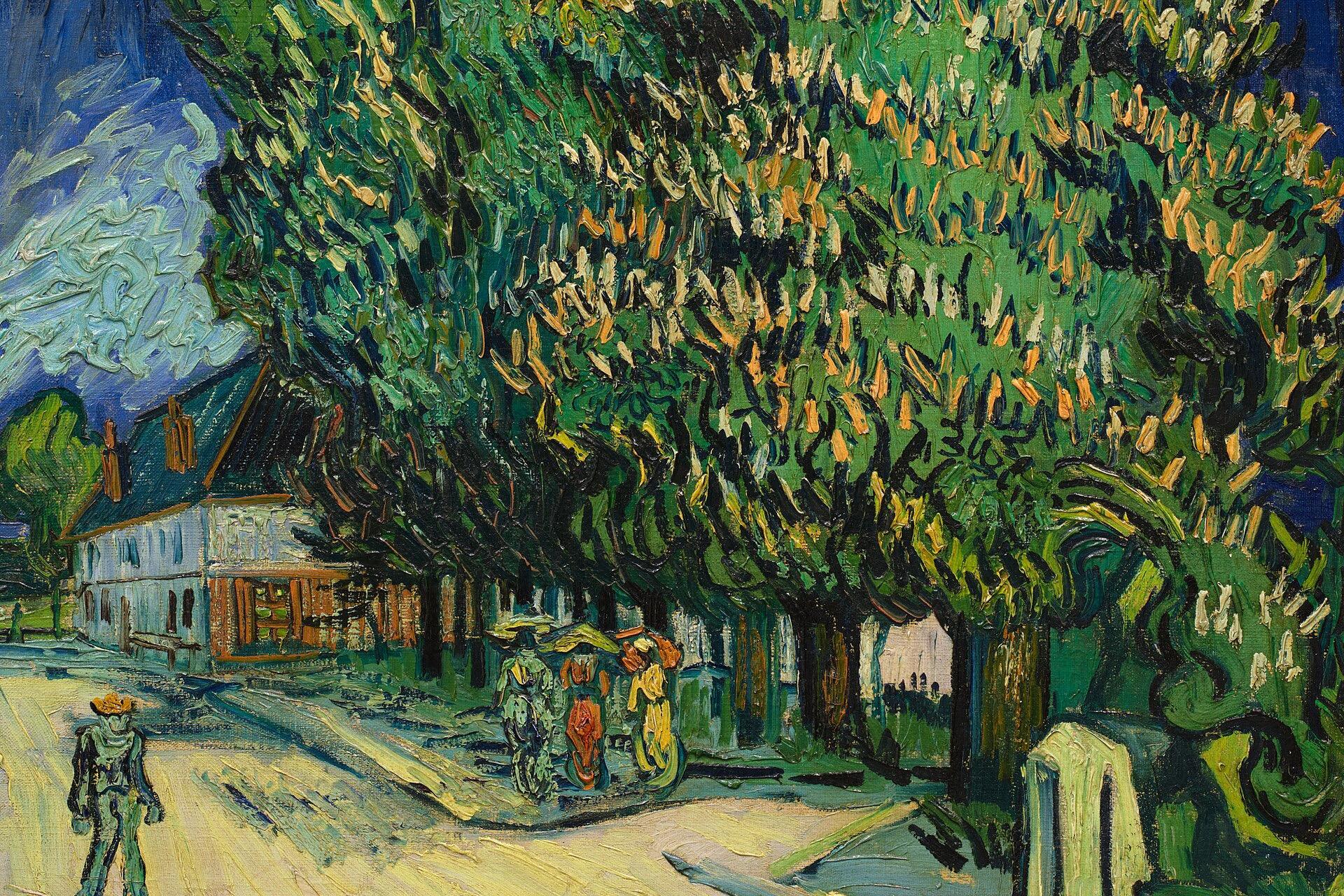
Much of the week's growth sits in a handful of lots. At Sotheby's on November 18, Vincent van Gogh's Châtaigniers en fleurs, painted at Auvers in May 1890, made $190.4 million with fees, $165 million at hammer, as reported by The Art Newspaper. It is a new auction record for the artist, well above the $117.2 million paid at Christie's in 2022 for Verger avec cyprès. The sale went ahead after a settlement, announced by Sotheby's the day before, between the Blaquier-Arrieta family and the descendants of Samuel and Hedwig Fischer, who owned the painting before the Nazi era. From the same collection, Paul Cézanne's harlequin made $111 million, as reported by USA Art News.
Those two lots alone are worth about $300 million, more than the week's entire increase over last year, which comes to about $210 million. Strip them out and New York would have come in below November 2025.
At Christie's the night before, the 20th Century Evening Sale made $626.6 million, with 92% of lots sold and 95% by value, as reported by Artcentron. Wassily Kandinsky's Betonte Ecken (1922 to 1923) set a record for the artist at $85.8 million, against a previous high of $44.8 million. Gustav Klimt's Litzlbergkeller (1915 to 1916), reported as guaranteed and estimated at $60 to $80 million, made $82.3 million. Those are serious prices for serious pictures. They are also prices for the early twentieth century, not for anyone alive.
The collections sold, below their price
Our question last week assumed that the single-owner sales were the safe part of the week. They were safe in the sense that they sold. The Blaquier-Arrieta collection, twelve works, made $358 million at hammer, $412 million with fees, as reported by The Art Newspaper, against an estimate of around $450 million. The collection that produced the week's record finished about $90 million under its own estimate at hammer, and it had been guaranteed by the house before the sale.
Christie's leaned on collections in the same way. As reported by Artcentron, six of them, led by a group catalogued as Heroes and Lovers at $104.7 million, then the collections of William I. Koch, Herbert Lust, Antonio Homem Sonnabend, Agnes Gund and Clive Davis, together accounted for nearly $350 million of the week.
So we would revise the line we ended on a week ago. The market is buying provenance stories, yes. It is not paying the estimate for them. A name on the catalogue cover brings the room in. It no longer sets the price.
The middle, and the living
The contemporary end tells the rest. Christie's 21st Century Evening Sale made $145.9 million, or $117.7 million at hammer, as reported by Artcentron. Its top lot, a 1983 Jean-Michel Basquiat, Untitled (Leonardo and His Five Grotesque Heads), made $32.9 million with fees, a result USA Art News describes as below its estimate. Advisers quoted by USA Art News pointed the same way. Lauren Bender spoke of "aggressive estimates" and "an abundance of quality hitting the block." Betsy Bickar said that "even clients who conducted significant due diligence on the works and on the pricing wanted to remain conservative." Andrew Massad put it more sharply: "the art your grandparents owned is the new New Now."
That sentence is a joke, and it is also the week's most accurate summary. The money went to Van Gogh, Cézanne, Kandinsky, Klimt and a 1960 Kusama. It went less readily to the generation of contemporary painting that carried the market from 2017 to 2022. It is the same flight to quality we tracked in the first half, extended backwards in time.
What to watch
On the other question from last week, whether the Kusama record would bring out the paintings consignors have been holding since her death, the week gave no answer: the record sold on Monday and none of the reported results later in the week involved a major Kusama painting. The test moves to the spring sales, and to Hong Kong, where her first post-death outing in October found a price but not a premium.
The other thing to watch is simpler. If estimates for May are set off this November's hammer prices rather than off its fee-inclusive totals, the houses will have learned the week's lesson. If they are set off the $2.44 billion, expect another season in which the total rises and a third of the lots still fall short.
Week total, prior-year comparison, evening and day sale totals, house totals and lot counts, the Cézanne price, the Basquiat result against its estimate and the advisers' quotes as reported by Sarah Mitchell in USA Art News (November 21, 2026), citing Artnet News. Hammer total of the four evening sales, its comparison with the presale low estimate, the share of lots above high estimate, below low estimate and unsold, and the guarantee coverage as reported by Sheena Carrington in MyArtBroker (updated November 22, 2026). Van Gogh price, hammer and previous record, the Fischer settlement and the Blaquier-Arrieta collection totals and estimate as reported by The Art Newspaper (November 19, 2026). Christie's 20th and 21st Century sale totals, sell-through rates, the Kandinsky, Klimt and Basquiat prices, the previous Kandinsky record and the collection totals as reported by Kazeem Adeleke in Artcentron (November 23, 2026). The guarantee on the Blaquier-Arrieta collection as reported by Judith Benhamou Reports. The $2.4 billion expectation as reported by The Art Newspaper on November 16, cited in our note on the opening night. Prices include buyer's premium unless given as hammer. The comparison of bases, the reading of the two Sotheby's lots against the week's growth and the rest of the interpretation are ours. Image: Vincent van Gogh, Châtaigniers en fleurs, 1890, public domain, via Wikimedia Commons. This is desk coverage.