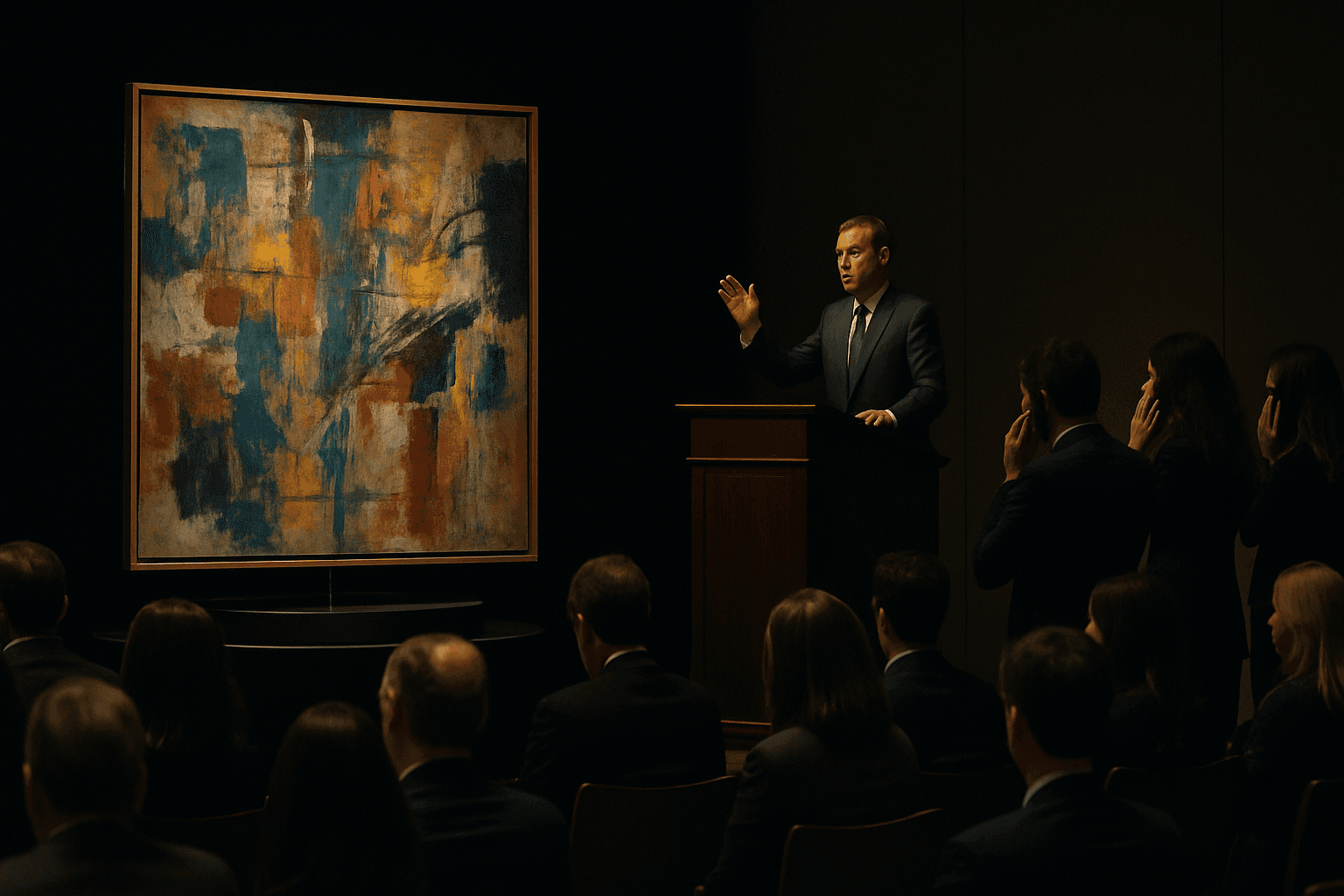
The first half of 2026 gave the auction houses their best sequence since the correction began. In early July, an untitled 1984 collaboration between Jean-Michel Basquiat and Andy Warhol took $19.4 million at Sotheby's Contemporary Evening Sale, headlining a season that had been building since the spring.
Totals are the wrong lens. Read the same six months by category and the picture is narrower than the headline suggests.
What the money actually bought
The consistent pattern across the half was a flight to quality: collectors redirecting attention toward postwar masters and modern art, where supply is scarce and demand is more durable.
A large-scale Basquiat and Warhol collaboration is the perfect expression of that. Two artists whose markets are fully formed, both dead, both with completed institutional records and finite output, in a work whose scarcity is doubled by being a collaboration. There is no thesis to accept. The price rests entirely on comparables.
The Art Newspaper made the same reading from the other direction in June: blue chip getting a boost while edgier art remained in the doldrums. Both halves of that sentence are the finding. A season can be good and narrow at once.
Why one good season is not a turn
The most useful piece of analysis published all half came at the end of June, when The Art Newspaper argued that one season of successful auctions will not transform the art market. That is worth taking seriously rather than treating as caution for its own sake.
Auction results are supply-driven. A strong evening sale means the houses secured strong consignments, which usually means an estate settled, a collection was divided, or a guarantee was attractive enough to pry a work loose. None of those are demand signals. A market can produce record evening sales for two years on inherited supply while the primary market, where new work is sold for the first time, deteriorates underneath.
That is roughly what the Art Basel and UBS report described for 2025: public auction up 9%, the dealer sector up 2%.
The other half of the ledger
The same months that produced the Basquiat and Warhol result also removed galleries from the map. Dépendance in Brussels and Tiwani Contemporary in London both closed in June, under cost pressure that has been building across the middle of the market. We looked at that separately in our piece on the closures.
Put the two facts in one sentence and the half becomes legible. A record collaboration price at Sotheby's, and two respected galleries with real programs shutting in the same month.
That is not a contradiction. It is what a flight to quality looks like from the ground: money concentrating into the narrow band of the market where it feels certain, and draining out of the band where reputations are still being built. The auction total goes up. The number of places where a young artist can be shown goes down.
What to watch in H2
The autumn sales in London and Paris, then the New York November season, then Art Basel Miami Beach in December.
The specific thing to look for is not the top lot. It is whether the contemporary day sales and the sub-$20,000 fair market hold. In December 2025 that tier was the most encouraging fact of Miami Art Week. If it holds again in a year that has otherwise rewarded only the dead and the canonical, the recovery is broader than this half made it look.
Sale result as reported by Sotheby's and collected in contemporaneous coverage from Artnet and ARTnews. Hammer and premium conventions differ between houses; reported totals include buyer's premium unless stated otherwise.