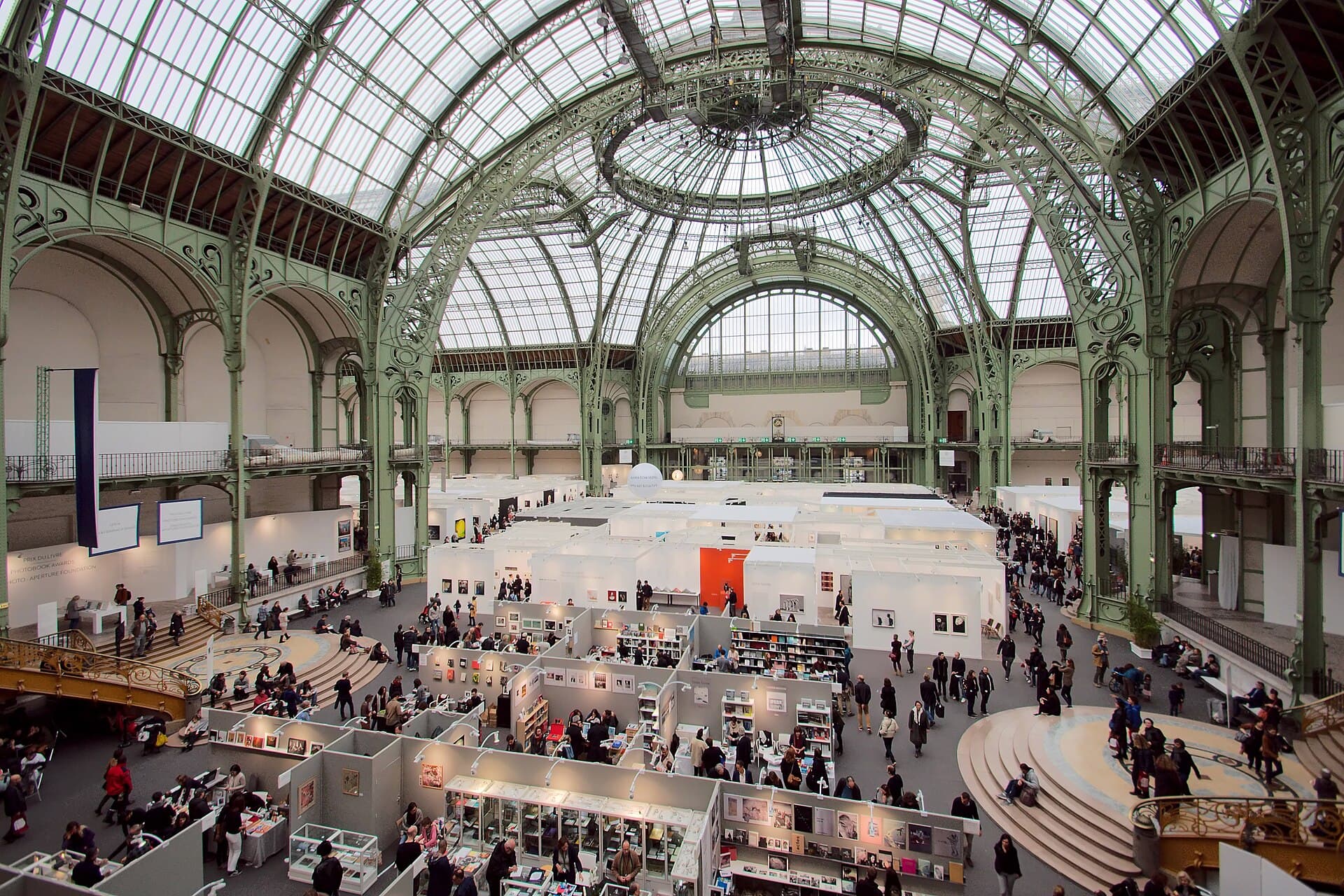
The fifth Art Basel Paris was meant to run at the Grand Palais until Sunday, October 25. It ended at 7pm on Friday, October 23. As reported by The Art Newspaper, an email to VIP guests co-signed by director Karim Crippa announced that the fair would stay closed on Saturday and Sunday, after mass demonstrations across France against the cost of living and school conditions turned into riots and looting the weekend before, and further protests were called for central Paris. Art Basel said it deeply regretted being unable to welcome visitors that weekend, as reported by Finestre sull'Arte, and offered galleries logistical help to dismantle early. Holders of weekend tickets were to be contacted directly.
Art Basel's own German-language release, as reported by Finestre sull'Arte, called the decision unprecedented. It is also the most revealing thing that has happened to the fair format this year, because of what it did not change.
The ledger did not move
On Sunday, the day the fair should have closed, Art Basel published its selection of reported sales as it does every year. As reported by Artlyst, the list was long and the top of it was heavy.
Hauser & Wirth sold two paintings from 1965 at around $10 million each: Gerhard Richter's photo painting Rokokotisch (Rococo Table) and Georg Baselitz's Der Hirte (The Shepherd). The Art Newspaper put the Richter at $10.5 million and dated it to the Avant-Première on Tuesday afternoon. David Zwirner reported a Richter at $8.5 million, a Robert Ryman at $4 million, a Joan Mitchell at $3.8 million and a Marlene Dumas at $3 million. White Cube sold two Julie Mehretu paintings at $7.85 million each, one of them Rise of the New Suprematists (2001), reported on the first day. Pace placed Jean Dubuffet's La chaise (1964) for over $5 million.
Then the institutions, which are the part of a fair report we trust most because a museum has to account for what it buys. As reported by The Art Newspaper, Pilar Corrias sold Christina Quarles's Aerial! (2026) to a museum in the American Midwest. In Artlyst's reading of the fair's list, P.P.O.W. placed a Martin Wong at $1.75 million with an American institution, and Standard (Oslo) sold Suleman Aqeel Khilji's Mnemonic Spaces II for €60,000 to an Australian museum collection.
None of this reads like a fair that lost two days. That is the finding.
The Avant-Première question, answered by force
In September, previewing the edition, we said the part of the fair we would watch most closely was the invitation-only Avant-Première on Tuesday, October 20, the tier that produced last year's $23 million Richter. The test we set was simple: how many of the top transactions would be dated to that Tuesday, and how many to the days the public could walk in.
We expected to answer it with timestamps. Paris answered it by removing the public days altogether. The Avant-Première ran from 3pm to 7pm on Tuesday, and, as reported by The Art Newspaper, each gallery could invite six of its top clients, each with a guest. That room, and the two Preview Days after it, carried the edition. The weekend the city lost was, commercially, the weekend the fair could most afford to lose. As Artlyst put it, serious collectors had largely finished buying during the midweek VIP days.
We want to be careful with what this proves. The published list is a selection: exhibitors choose what to report, many prices are ranges or asking figures, and nothing in it is audited. Artlyst called it "a snapshot, not a full ledger," which is right. The galleries that depend on the weekend, the younger programs in Emergence, the stands that sell at €2,500 to €3,000 to people who walked in off the Avenue Winston-Churchill, do not show up in a list that leads with eight figures. Exo Exo's paintings by Yann Stéphane Bisso, at €2,500 to €3,000 each, are on it, and we would like to know how many of those were bought on a Saturday that never happened.
But the shape is now beyond argument. A fair this size can close its doors to the public and lose very little of what it exists to sell. That is not a criticism of the decision to close, which was the right one. It is a description of what Art Basel Paris has become.
The city program was the part that was lost
There is a harder irony here, and it is the one we flagged in September. This was the edition built to move the fair out into Paris: a public program across nine sites, from the Petit Palais to Square Jean Perrin, an actress-curated rehang for the Saturday crowd, talks in the Grand Palais Auditorium. As reported by Finestre sull'Arte, Alicja Kwade's tower of stone spheres outside the building was taken down on the Friday.
So the outward-facing half of the edition, the half that argued the fair belongs to the city rather than renting it, is exactly what the closure took away. The inward-facing half, the Tuesday room with six invitations per gallery, was untouched. Crippa's fair wanted to be read as part of Paris. For five days this October, events in Paris decided that it would be read as what it also is: a very efficient private sale with a public weekend attached.
London's mark, cleared with old paintings
A week ago, closing our Frieze coverage, we noted that London's top price was a £5 million Brueghel at Frieze Masters, and asked whether Paris would clear it with contemporary work, as it did last year with the Richter. If it did, we said, the season would look like a division of labour: London sells the new, Masters sells the old, and the Grand Palais takes the top.
Paris cleared it. At around $10 million, the Richter and the Baselitz each roughly doubled the Brueghel. But both were painted in 1965, sixty-one years ago, by artists whose markets were made in the last century. The highest reported price for a work made this year was $2.95 million, for George Condo's Woman with Designer Shirt (2026) at Hauser & Wirth, with Sprüth Magers placing two more 2026 Condos at $2.2 million each. That is above London's contemporary ceiling of $1.5 million, and well below the historical one on either side of the Channel.
So the division of labour holds, with an amendment. The Grand Palais does take the top, but what it takes the top with is post-war history, not new work. And the top itself has come down: last year's Paris headline was $23 million. This year the best reported price is less than half that.
The largest number of the week, meanwhile, was not a sale. As reported by The Art Newspaper, Pace with Di Donna and Schrader offered Amedeo Modigliani's Nu étendu (Lolotte) (1917) at an asking price of over $100 million. We have seen no report that it sold. Gladstone's J.M.W. Turner watercolour at $380,000 was also still on the wall on the second day. A $100 million painting brought to a fair is a statement about where the very top of the market wants to be seen. A $100 million painting that does not sell there is a statement about where it still prefers to be sold, which is privately or in an evening sale in New York next month.
What we are watching now
Sprüth Magers's Andreas Gegner told The Art Newspaper that many collectors "had already booked and decided to come anyway." Next year Art Basel will have to decide whether the lesson of 2026 is that the public days are dispensable, or that they are the part worth protecting. We hope it is the second, and we suspect the commercial incentive points to the first.
The next room on the circuit is Miami Beach, from December 4 to 6, with Preview Days on December 2 and 3. We will be counting the same thing there: what sells before the public arrives, and what is left for the people who buy a ticket.
Closure date, time and reasons, the email co-signed by Karim Crippa and the Mehretu sale from The Art Newspaper (Gareth Harris, October 22, 2026). Avant-Première format and invitations, the $10.5 million Richter, the Quarles museum sale, the Modigliani asking price, the unsold Turner and Andreas Gegner's remark from The Art Newspaper (Georgina Adam, October 21, 2026). Art Basel's statement, weekend tickets, the Kwade dismantling and the public program sites from Finestre sull'Arte (October 22, 2026). All other sale prices, the institutional acquisitions by P.P.O.W. and Standard (Oslo), and the "snapshot, not a full ledger" assessment from Artlyst (News Desk, October 25, 2026), reading the selection of sales published by Art Basel. Sale prices are as reported by the galleries and the organizer, not independently verified. This is desk coverage.