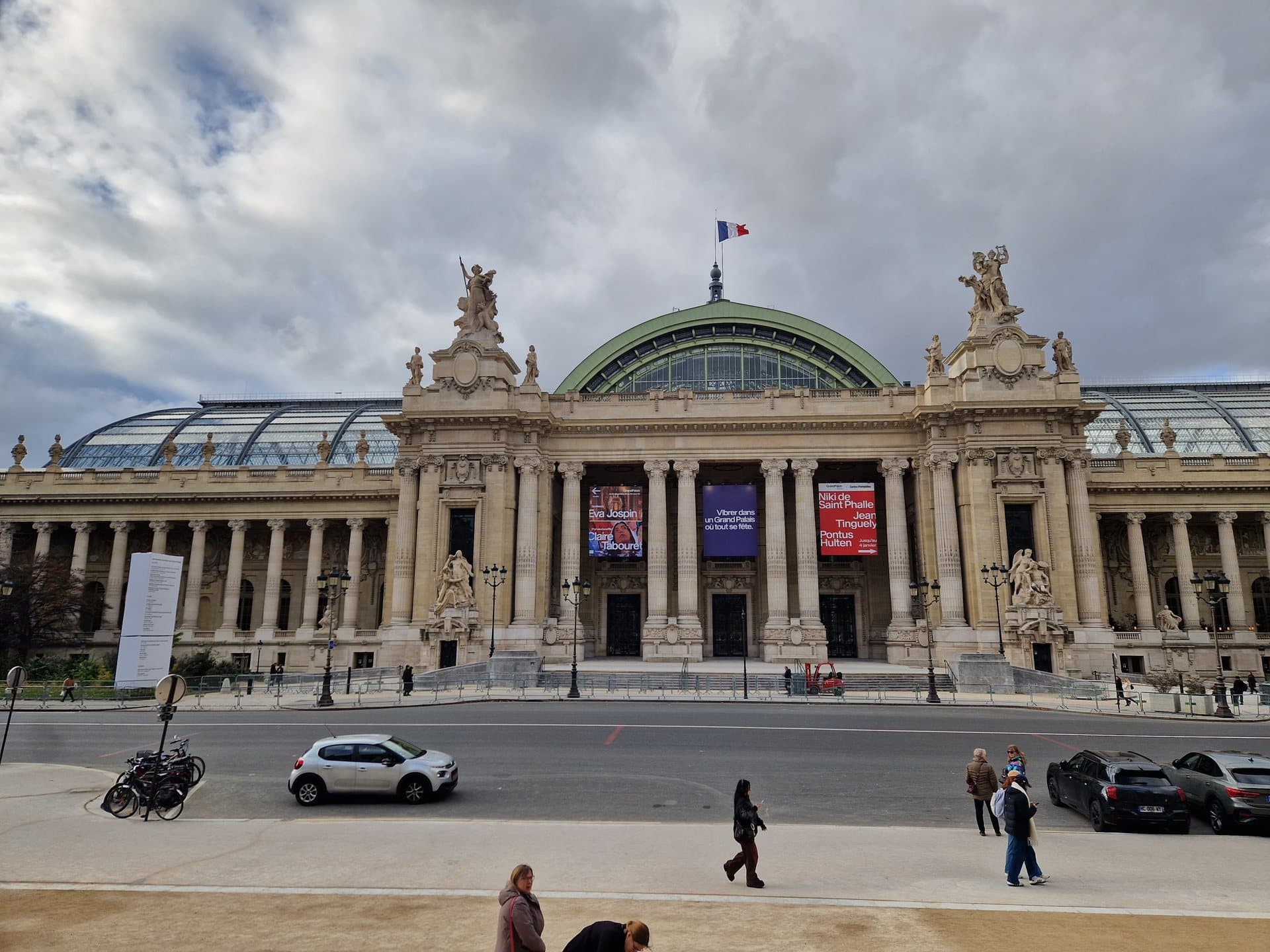
Art Basel Paris returns to the Grand Palais from October 23 to 25, 2026, with Preview Days on October 21 and 22 and a public Vernissage on the evening of the 22nd. The fifth edition brings together 211 galleries from 41 countries and territories, with 32 taking part for the first time and 64 operating spaces in France, according to the program announcement the fair sent to press on September 21.
It is also the first edition under Karim Crippa, who took over as director on November 1, 2025, after Clément Delépine, who launched the Paris fair in 2022, moved to Lafayette Anticipations. Crippa is Zurich-born, joined Art Basel in 2018 and ran communications for the Paris fair before he ran the fair itself. Speaking to Art Basel's editorial team, he describes Paris as "a very young city, marked by genuine diversity and a desire for experimentation," and his fair as "smaller and more intimate than those in Basel and Miami Beach."
That is a positioning, and the program announced this week is built to match it.
The fair is moving out of the building
The headline change is geographic. The Public Program, with Miu Miu as official partner, now runs across nine sites: the Petit Palais, the Palais d'Iéna, the Cité de l'architecture et du patrimoine, the Parvis des Droits-de-l'Homme, the Beaux-Arts de Paris, Avenue Winston-Churchill, Square Jean Perrin, Place Clemenceau and the Jardin de la Nouvelle-France.
Inside the Grand Palais, two further moves point the same way. Conversations, the talks program, moves into the Grand Palais Auditorium for the first time. And Oh La La! returns on October 23 and 24, with the French actress Philippine Leroy-Beaulieu art-directing a two-day rehang around the theme Myths and Legends.
Read together, these are a fair making the case that it belongs to Paris rather than to the calendar. In 2022 Art Basel took over the October slot that had belonged to FIAC for decades, and for its first editions the question was whether a Swiss company could hold a French week. Four editions later, the fair is putting its program into the squares and museums around its building, which is what an event does when it wants to be read as part of the city instead of as its tenant.
Premise, joint booths and the shape of the floor
Two sector changes are worth reading closely.
Premise, the sector for research-led presentations that revisit established narratives of art history, moves into the Salon Seine. Crippa puts the expanded sector at 900 square meters and 12 booths, compared with nine last year, and calls the idea of widening the canon "something truly Parisian."
The fair also has a record 12 joint booths, bringing together 24 galleries. Art Basel presents them as new dialogues between programs, and some will be exactly that. They are also, unavoidably, a shared invoice. In a year when middle-market closures have been the story of the gallery sector, and when the stand fee is only the first line of a fair budget, a record number of shared stands at the most expensive week in the European calendar says something about who can still take a wall of their own at the Grand Palais.
The preview question carries over from 2025
The part of the fair we will watch most closely is the one the program announcement mentions least. Avant-Première, the invitation-only preview for galleries and their principal clients, returns for its second edition on October 20. In Crippa's words, it lets galleries invite their most loyal clients on the Tuesday afternoon, the day before the VIP opening.
Last year that tier produced the fair's largest sale, a Gerhard Richter placed by Hauser & Wirth for $23 million, and we argued at the time that concentrating top-end buying into narrower, earlier windows was the real product of the edition. Art Basel has since carried the logic across its calendar, from Hong Kong to Basel.
There is a tension with this week's message. A fair that opens outward to nine public sites and an actress-curated rehang is also a fair that begins, a full day earlier, in its most exclusive room. Both can be true at once. What will tell us which one is doing the commercial work is the timing of the reported sales: how many of the edition's top transactions are dated to Tuesday, October 20, and how many to the days the public can walk in.
The market it is selling into
Art Basel frames the edition against France's position in the trade. By the fair's figures, France accounts for 8% of the global art market, the fourth-largest worldwide and the largest in the European Union, with sales of $4.5 billion in 2025, up 9% year on year.
The calendar adds its own pressure. Frieze London and Frieze Masters close on October 18 (our preview), five days before Paris opens to the public. The collectors who do both weeks will reach the Grand Palais having already bought once, and the galleries in Salon Seine and in the joint booths will be selling to what is left.
Dates, gallery counts, sector changes and public program sites as announced by Art Basel in its press release of September 21, 2026 and its exhibitor announcement, which is also the source of the French market figures. Crippa's remarks from his interview with Matthieu Jacquet, published by Art Basel. Leadership change per Art Basel's announcement and ArtReview.