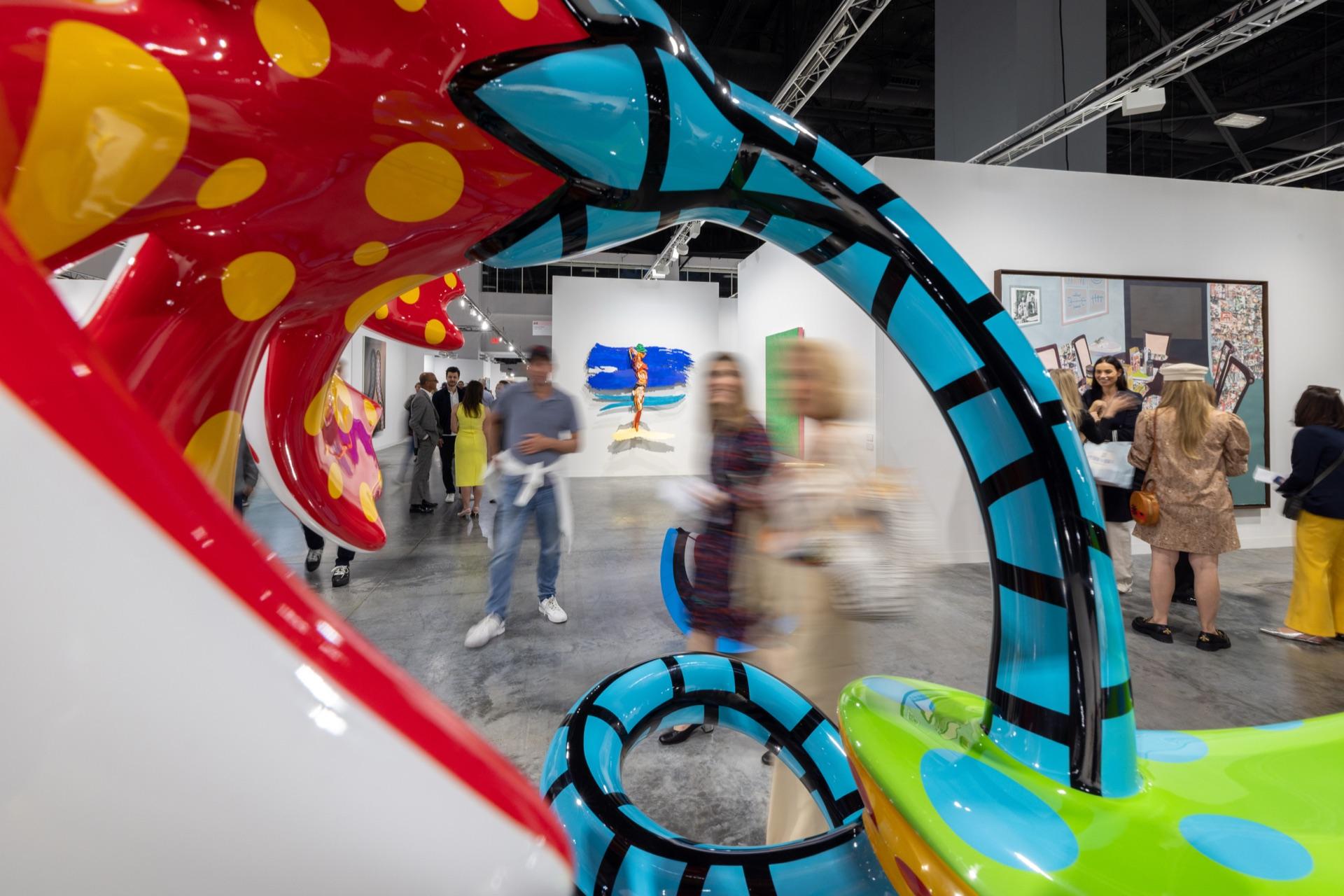
Art Basel released the second round of its Miami Beach announcements on November 19, and the shape of it says a good deal about how the group now thinks about December. The fair itself is unchanged since September's line-up: 272 exhibitors from more than 40 countries and territories, at the Miami Beach Convention Center from December 4 to 6, with VIP Preview Days on December 2 and 3 and UBS as Global Lead Partner. What is new is everything wrapped around it: named booths, a fuller Zero 10, the complete Conversations program and the night of the Art Basel Awards.
Read in the order Art Basel presents it, the release is a list. Read for what it argues, it is two documents stapled together. One is about art and is unusually precise. The other is about reach, and it is the one that will be photographed.
The floor, where the precision is
The single most interesting object announced is Rosana Paulino's Crisálida (2025–26), her first bronze sculpture, shown by Mendes Wood DM. According to Art Basel, the work was made for the exterior of the Brazilian Pavilion at this year's Venice Biennale, where Paulino shares the exhibition Comigo ninguém pode with Adriana Varejão, curated by Diane Lima for the Fundação Bienal de São Paulo. Venice closes on November 22. Twelve days later, the same sculpture stands in a commercial booth in Florida.
That is how the circuit works now, and it is worth saying plainly rather than pretending otherwise. A national pavilion is a stage built with public money; an art fair is where its value is tested. Paulino's work has spent three decades on the colonial body and the violence of classification, and a chrysalis cast in bronze, the most permanent of materials for a form defined by transformation, is a sharp idea. Whether it reads as sharply under convention-centre lighting, between a hospitality plaza and an aisle sign, is the question the booth has to answer. We think it can. Mendes Wood DM is surrounding it with Sonia Gomes, Edgar Calel and Lygia Pape, which is a curatorial argument about Brazilian abstraction and the body rather than a sales wall.
The second presentation worth the walk is the joint booth of Ortuzar and Crèvecœur, built around Ernie Barnes, with Shootin' the Breeze (1974) and Homecoming (1994) alongside Claire Falkenstein, Francis Picabia, Emma Reyes, Donna Huddleston and Sol Calero. Art Basel says it coincides with an exhibition of Barnes's work at ICA Miami. A New York dealer and a Paris dealer sharing one stand is in itself a statement about how the middle of the market is choosing to survive: split the rent, combine the lists, make one argument instead of two weaker ones. The argument here is a good one. Barnes, a professional footballer before he was a painter, spent his career being filed under sport and illustration. Placing him next to Picabia and Falkenstein files him under painting.
Elsewhere the list is reliable rather than surprising. David Kordansky brings Shara Hughes's Rough Patch (2026), Rashid Johnson, Huma Bhabha and a 1970 Sam Gilliam. Gladstone has Wangechi Mutu's Crocodylus (2020), a bronze more than four metres long, and a new Carrie Mae Weems. Mariane Ibrahim shows Lorraine O'Grady, Ayana V. Jackson and the beadwork of Big Chief Demond Melancon. And Spinello Projects, the Miami gallery we flagged in September for stepping up from Nova, makes its Galleries debut with a blue room for Elliot & Erick Jiménez, Marlon Portales and Nina Surel. On a floor that has scattered its blue chips to make people walk, those are the booths that benefit from the detour.
Zero 10 finds a past
Zero 10 returns under the theme Generation, its largest edition so far: 21 exhibitors across 19 projects, curated by Karen Archey with Eli Scheinman. Studio DRIFT's Murmuring Minds, thirty autonomous robots responding to visitors, makes its US debut with TAEX, and Art Blocks shows Emily Xie's embroidered works next to Refik Anadol, Sarah Meyohas, Jon Rafman and Harm van den Dorpel.
The decision that matters is the least spectacular one. The Institute for Studies on Latin American Art (ISLAA) brings ARTE Y CIBERNÉTICA, a historical presentation on early computer art in Latin America. In July we wrote that Zero 10's second year would be judged on whether it came back with prices attached. It may still not. But a digital sector that can show its own history, and locate part of that history in Buenos Aires and São Paulo rather than in Silicon Valley, is building the one thing robots and screens cannot supply: a canon to be priced against. That is a museum move inside a fair, and it is exactly what Archey was hired to make.
The Google Arts & Culture collaboration, a panel on December 4 titled What Is a Lab? Creative R&D Today with Hans Ulrich Obrist, Xin Liu and Zach Lieberman, is a talk. Useful, but a talk.
Conversations, or the fair as a stadium
The Conversations program runs from December 2 to 5. It opens with Julie Mehretu and Jeff Koons, organised with Qatar Creates Talks, and with Koo Jeong A in conversation with Emily Watlington. December 3 is given to Art & Sports: Kevin Love, Crystal Dunn, Clara Wu Tsai, Keith Rivers, a panel with UBS's head of sports and entertainment, and a session presented in official partnership with the NFL on portraiture and legacy in professional football. The same afternoon brings Swizz Beatz, Mickalene Thomas and Larry Ossei-Mensah.
There is nothing wrong with athletes who collect. Clara Wu Tsai is a serious patron, and Kevin Love has spoken about art for years. But a full day of sport at an art fair is a statement about audience, not about art. It tells sponsors that Art Basel can deliver the crowd that watches the NFL, and it tells that crowd that the fair is an experience available to them. The irony is that the one artist on the floor who actually made sport into a body of painting, Ernie Barnes, is on a gallery stand and not, as far as the program shows, on the stage. If the fair wanted a conversation about portraiture and legacy in professional football, it had the subject two halls away.
Awards night
The Art Basel Awards, presented with BOSS, reach their second edition on December 3 at the New World Center. The 2026 Gold Awardees, chosen by peer vote among the medalists, will be revealed there, and the second BOSS Award for Outstanding Achievement presented. The medalists were named in April, 33 of them across nine categories as reported by The Art Newspaper, among them Barbara Kruger, Howardena Pindell and Jenny Holzer as icon artists, and Julie Mehretu and Arthur Jafa among the established artists. Mehretu's appearance on the Conversations stage a day earlier is a neat bit of programming.
Beyond the Convention Center
The museum calendar remains the strongest part of the week, as we said in September: PAMM with Picasso, Klee, Matisse: Masterpieces from the Museum Berggruen and shows on Basquiat and Baldessari, The Bass with Yuko Mohri, Amalia Pica and Sarah Zapata, ICA Miami with a Carroll Dunham survey and Friedrich Kunath's first US museum solo. In Collins Park, Public Art Fund's Between Tides sets six playable, artist-designed ping-pong tables by Moko Fukuyama, Ilana Harris-Babou, Las Hermanas Iglesias, Carlos H. Matos, Amalia Pica and SUPERFLEX. It is the one place in the week where the sporting theme and the art actually meet, and you can play.
What we take from it
Art Basel has redesigned its Miami floor so that collectors walk further and see more. Its program, meanwhile, is designed so that more people who are not collectors come in. Both are reasonable ambitions; they are not the same ambition. The release spends most of its energy on the second. The best reasons to go are in the first: a bronze arriving straight from the Venice pavilion, a painter of the game finally hung beside Picabia, and a digital sector that has started to remember. We will be covering the fair from preview day, counting which of the two stories the sales report tells.
Fair dates, exhibitor count, gallery presentations, Zero 10 projects and curators, the ISLAA and Google Arts & Culture collaborations, the Conversations schedule, the Art Basel Awards Night and the museum and public program from Art Basel's announcement of November 19, 2026. The Brazilian Pavilion, its artists, curator and Biennale dates per the Fundação Bienal de São Paulo. Number and categories of the 2026 Art Basel Awards medalists as reported by The Art Newspaper. Press image courtesy of Art Basel. This is desk coverage ahead of the fair.