We were at L'hôtel de Maisons for the fourth edition of Design Miami Paris, which ran from October 20 to 25, 2026, with an invitation-only Preview Day on the 20th. It was the same week that protests closed Art Basel Paris at the Grand Palais two days early. Across the Seine, in the Faubourg Saint-Germain, the design fair kept its calendar: according to Design Miami, it concluded on Sunday, October 25, after welcoming more than 17,000 visitors over six days.
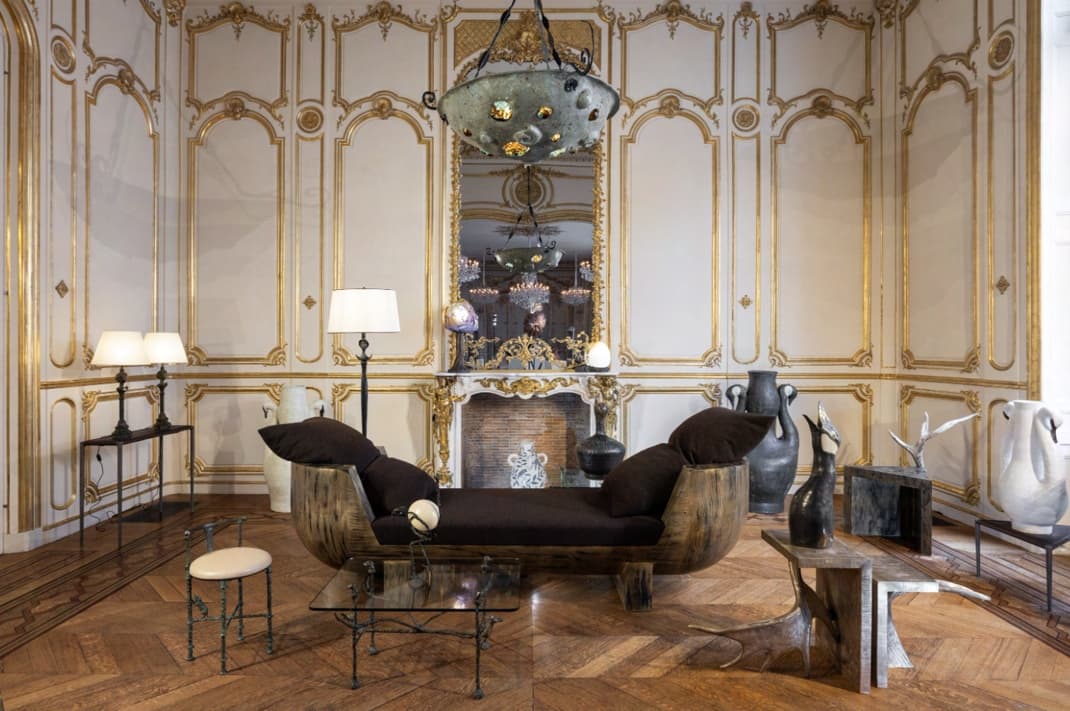
That contrast is the first thing to say about this edition, and it is not a small one. A fair spread across the rooms, courtyard and garden of an eighteenth-century hôtel particulier, the house where Karl Lagerfeld once lived, behaves less like an event than like a residence that happens to be open. It is harder to shut. It is also, as this year showed, a very persuasive place to sell.
The size of it
By the organizer's count, this was the largest Paris edition so far: 31 international galleries, more than 20 Design at Large presentations in the courtyard and gardens, nearly 50 exhibitors in all, and close to 1,000 works spanning more than 140 years, from an 1885 claret jug by Christopher Dresser to pieces finished this autumn. Grela Orihuela, the fair's director, put the theme more bluntly to Galerie magazine before the opening: "If we do have a theme, it is Paris!" The team, she added, gave up its own office to fit Boccara's artists' rugs into the house.
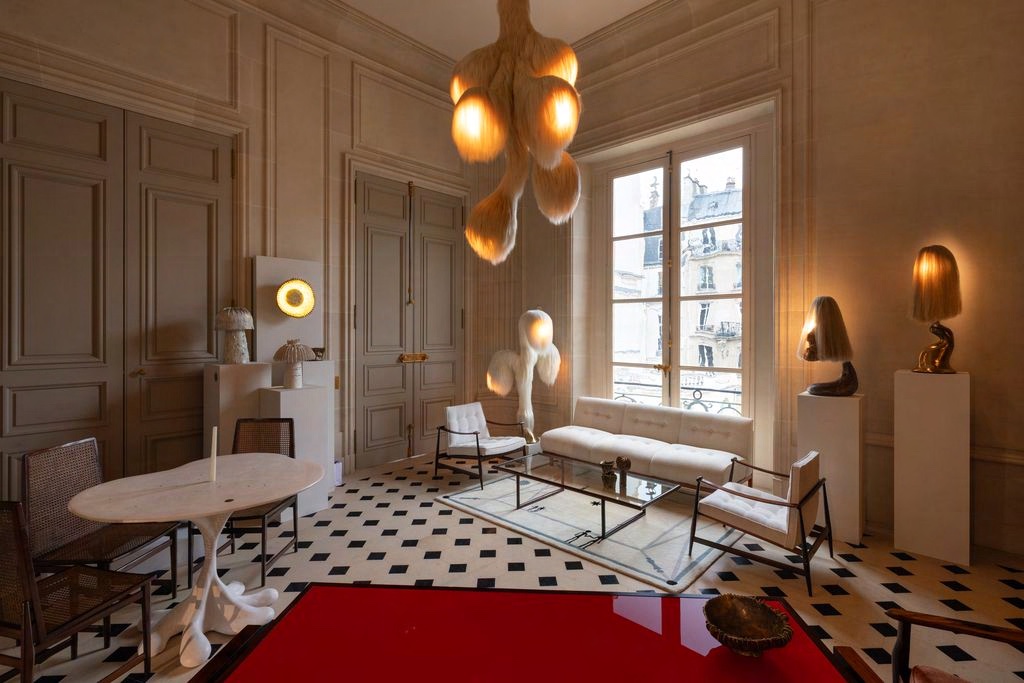
That candor is worth taking at face value. Design Miami Paris has no curatorial director and no theme statement, and it does not need one. The building does the framing. Parquet, boiserie and gilded overdoors tell a collector, before any dealer does, that the object in front of them belongs in a home of this order. It is a flattering argument, and the market responded to it.
The Giacomettis, and why they won
The fair's Best Gallery Presentation went to Salon 94 Design (New York), which set bronzes by Alberto and Diego Giacometti against contemporary work by Peter Schlesinger, Rick Owens, Urs Fischer and F. Taylor Colantonio. According to Design Miami's closing report, the gallery sold Alberto Giacometti's Lampe tête de femme, in two examples, and his Lampadaire modèle "figure", all circa 1933 to 1934, for between €400,000 and €500,000 each. Two works by Diego Giacometti, the Trapézoïdale low table aux cerfs et aux chiens (1963) and the Tabouret de coiffeuse à la Souris (1960), went for between €300,000 and €500,000 each. Owens's Double Bubble (Petite) (2026, edition of eight) placed for €50,000 to €150,000.
The pairing is the point, and it is a good one. Owens told Wallpaper* that the Giacometti Foundation is opening next to his house in Paris, and that the squalor of Alberto's studio was what he wanted his own home to look like. Put his brutalist pieces beside Diego's animal-legged tables in a gilded salon, and the stand makes a real claim: that the Giacomettis' furniture was always closer to sculpture than to decoration, and that the line runs forward to designers working now. The prize rewards that thesis. The prices reward the names. It would be naïve to pretend those are the same thing.
Scandinavia, quietly, made the most money per room
The result we would underline is not Salon 94's. Modernity (Stockholm), exhibiting for the first time, sold Josef Frank's Flora chest of drawers for Svenskt Tenn (1930s) and a unique 1939 cabinet by Otto Schulz for Boet for €240,000 each, plus a set of ten Kaare Klint Red Chair dining chairs for Rud Rasmussen (1928) for €145,000, as reported by the fair. For a debut, in a single ground-floor room, that is a strong week. It also confirms something the Paris calendar has been circling for a while: the appetite for Nordic modernism among collectors who used to buy French.
French modernism did not suffer for it. Galerie Chastel-Maréchal sold a Line Vautrin mirror for over €100,000; Laffanour | Galerie Downtown placed Charlotte Perriand's Bibliothèque (1959), a unique commission; Galerie Desprez Bréhéret sold a pair of Marcel Coard swan curule chairs (circa 1929). Yves Macaux Gallery (Brussels), last year's Best Gallery Presentation, sold a 1904 table by Josef Hoffmann, while its showpiece, Hoffmann's music cabinet for the Villa Bernatzik (1912 to 1913), kept by the family until 2024, was the kind of object the fair exists to surface.
The courtyard and the garden
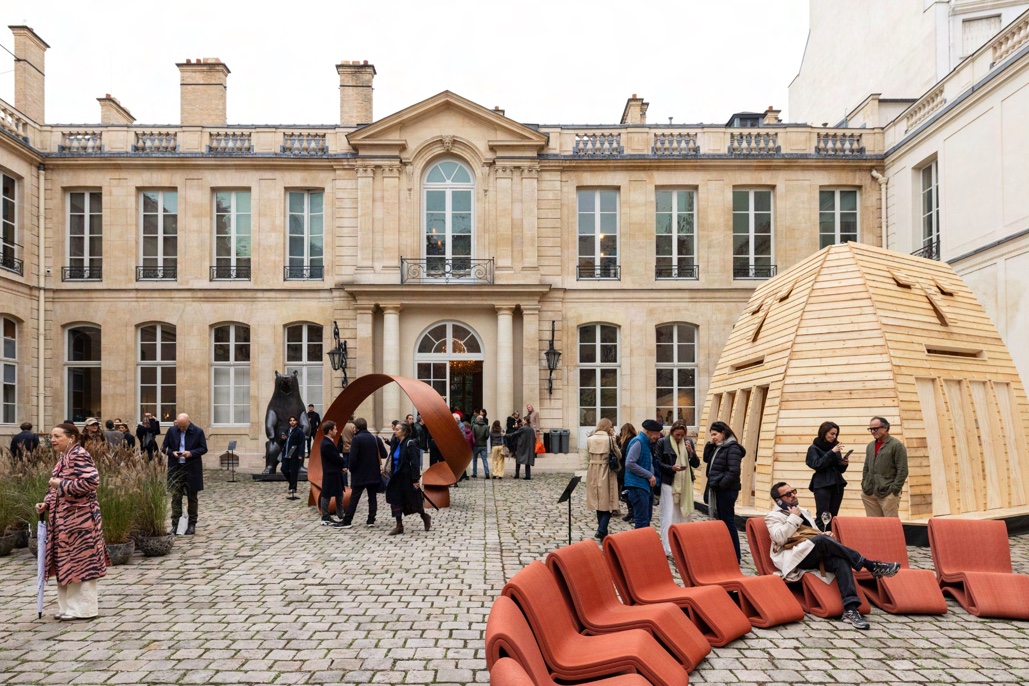
Design at Large is where the house works hardest. At the gate, Mitterrand installed François-Xavier Lalanne's Le Très Grand Ours, a three-metre bronze bear. Beside it, Pierre Renart's Arabesque, presented by maison parisienne, won Best Design at Large: a single ribbon of wood that rises from a bench into a chaise longue. Wallpaper* describes it as a 17-metre twisted ribbon of moabi. It is the most generous object in the fair, because it is the only one that asks to be sat on.
In the garden, Galerie Patrick Seguin brought back Jean Prouvé's 6x6 Demountable House (1944), this time fitted out as a Japanese tea house, with tatami and futons. Galerie magazine read this as proof that a system built for post-war emergency housing adapts easily to present taste. We are less sure that is a compliment. A house designed to shelter the displaced, dressed as a contemplative retreat for collectors, is a beautiful object and an uncomfortable one. Seguin has shown Prouvé's houses in this garden before, and the dressing is new each time. At some point the question of what the house was for deserves to be part of the display.
The new generation, and the price floor
The fair's other story was the arrival of younger galleries. Pulp Galerie (Paris), whose co-founder Paul-Louis Betto is 27, took over the garage with radical 1980s design and sold Gaetano Pesce's unique Chiat\Day Desk (1994). The A/P Room (Dubai), also new, paired Brazilian modernism with contemporary lighting and sold a 1966 work desk by Joaquim Tenreiro, a jacaranda coffee table by Jorge Zalszupin (1960) and two new Character Study works by Rogan Gregory. Mitterrand sold out its presentation of Julie Hamisky, at €20,000 to €85,000 a piece. In the garden, Room57 Gallery placed Leo Orta's unique Blushing Leaf chair (2026) for $52,000.
At the other end, Galerie MiniMasterpiece sold artists' jewelry by Pierre Charpin, Franz Erhard Walther and Yann Delacour from around €600 to €5,000. Walther's piece is the first jewelry the German artist has ever made, according to the fair. In a room where lamps cost half a million euros, a €600 ring by a living artist is not a footnote. It is the only door into this market that most visitors could open.
What Paris is now for
Jen Roberts, Design Miami's chief executive, said in the closing release that design "is now one of the main reasons collectors come to Paris in October." That is a claim from an organizer, and it should be read as one. But the week's sequence lends it weight. When the art fair lost its weekend, the design fair in the mansion carried on, sold historic material at prices that would not look out of place at the Grand Palais, and gave a debut gallery from Stockholm €240,000 for a single 1939 cabinet.
The risk is the one we flagged at Design Miami's twentieth edition in Miami Beach: an anniversary-proof formula that rewards attribution over invention. Paris answers it better than Miami does, because the house forces a mix of centuries into every room. The next test is the flagship in December, and beyond it a circuit that now runs from Seoul to Dubai.
Dates, exhibitor counts, visitor figures, awards, Best of Show jury and all sales and price ranges from Design Miami's opening release of October 21, 2026 and closing release of October 27, 2026, via the fair's press room. Grela Orihuela, Paul-Louis Betto and the Prouvé tea-house fit-out as reported by Galerie (Caroline Roux, October 12, 2026). Rick Owens's remarks and the dimensions of the Renart bench as reported by Wallpaper* (Amy Serafin, October 22, 2026). The Art Basel Paris closure as we reported it here. Press images by Ivan Erofeev, courtesy of Design Miami.