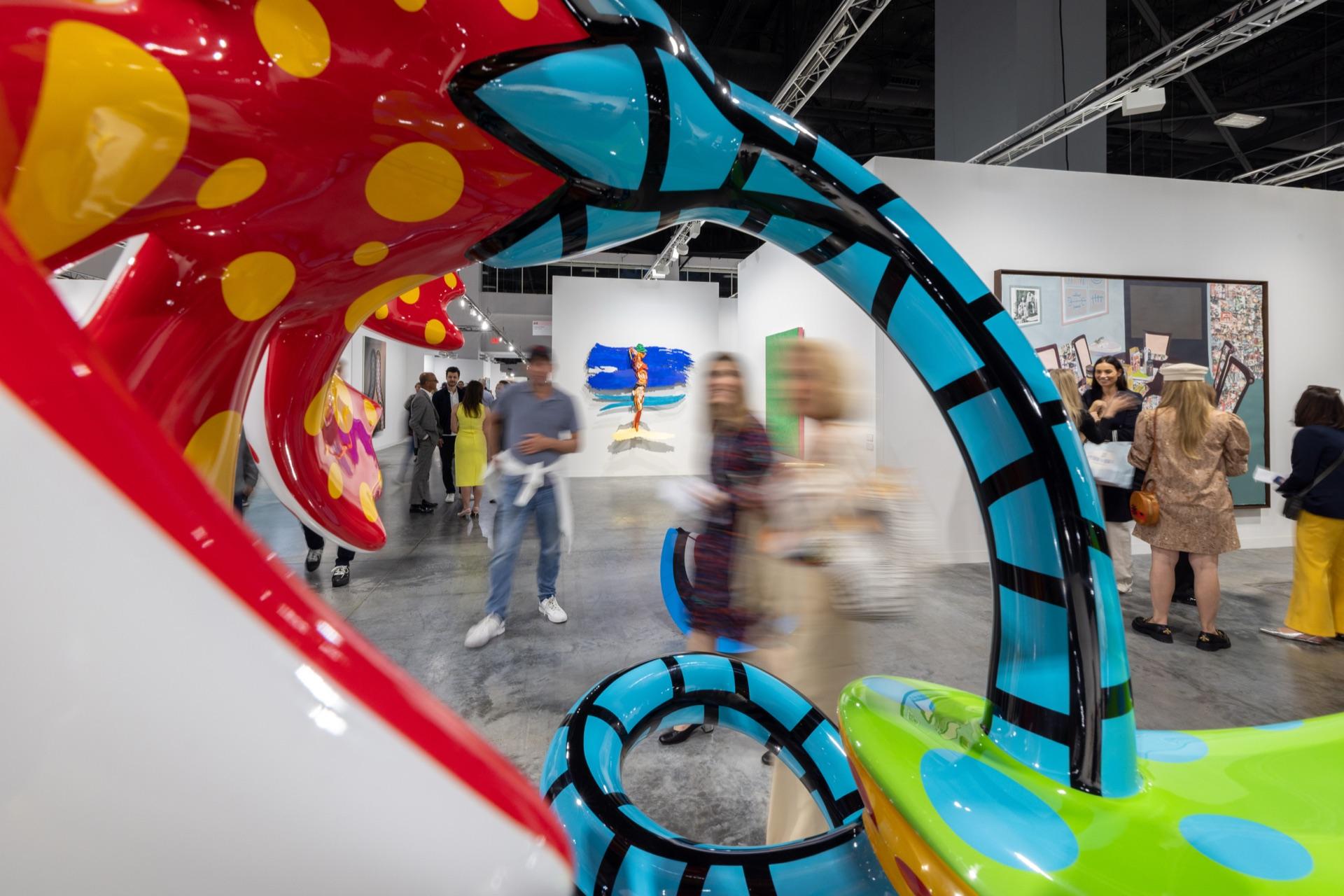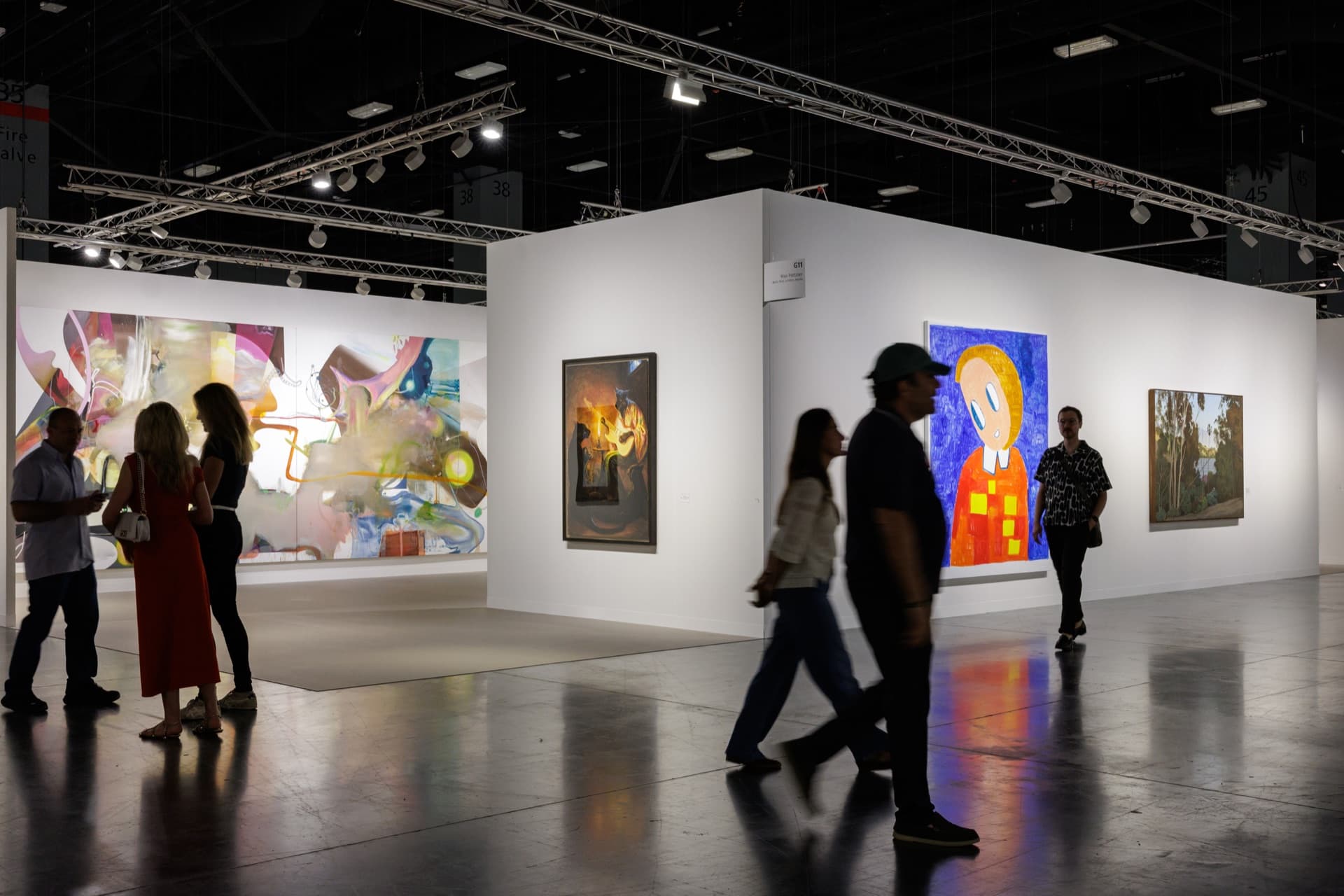
Art Basel announced its line-up for the December edition on September 29, and the number that matters is not the one in the headline. Art Basel Miami Beach returns to the Miami Beach Convention Center from December 4 to 6, 2026, with VIP Preview Days on December 2 and 3, with 272 exhibitors from more than 40 countries and territories. The fair will occupy around 12% less floor space, and its main sector, Galleries, will be around 10% smaller: as reported by The Art Newspaper, it drops from 226 exhibitors last year to 204.
Art Basel does not usually shrink. Over the past two years it has done the opposite, adding a fifth fair in Doha, adding preview tiers in Paris and Basel, adding Zero 10. So a Miami that is deliberately smaller is the most interesting thing the group has announced this autumn, and it deserves to be read for what it gives up as much as for what it promises.
The floor plan is the argument
The reconfiguration is organised around four hospitality plazas instead of five, which Art Basel says will open longer sightlines across the hall. More consequentially, the blue-chip galleries that used to be grouped in one part of the floor will now be spread across it, "placing programs of different scales, profiles, and geographies in closer proximity," in the fair's words.
The old geography was easy to read. There was a part of the hall where Gagosian, Hauser & Wirth, David Zwirner, White Cube and Pace stood within a few aisles of each other, and a collector with a short list and a dinner at eight could do the fair in that rectangle and leave. Dispersing those stands is a decision about traffic. It forces the person who came for the eight-figure booth to walk past the twenty-thousand-dollar one on the way.
Director Bridget Finn frames it as discovery: "When collectors move beyond familiar routes, discovery follows, and that is where the most meaningful conversations begin." That is the generous reading, and it is partly right. The Art Newspaper points out that Frieze made a comparable move in London two years ago, putting its blue-chip and established galleries at the back so that visitors had to cross the emerging aisles first. That kind of layout changes who gets looked at. Whether it changes who gets bought from is a separate question, and nobody has published an answer.
The less generous reading is that a fair which had become top-heavy is trying to protect the middle of its own floor. All year we have been tracking how the preview tier swallows the sale: in Hong Kong, most of the seven-figure deals happened before the public arrived, and in Paris the fair lost its whole public weekend and the sales report barely registered it. When the big transactions are done in a few hours on preview day, the mid-sized gallery's best chance is the collector who stays longer than planned. Scattering the blue chips is a way of making everyone stay longer. We think it is a sound idea. We also think it is an admission of the problem we have been describing.
Fewer, and who left
A smaller sector means some galleries had to go. As reported by The Art Newspaper, among the 2025 exhibitors not returning are Commonwealth and Council and Night Gallery from Los Angeles, Gallery Hyundai from Seoul, Gallery Wendi Norris from San Francisco, kurimanzutto, Pippy Houldsworth, Richard Saltoun and Ellie Rines. Art Basel does not say which absences were its choice and which were the galleries', and we will not guess. kurimanzutto also skipped the second Doha edition, which makes it a name to watch across the whole circuit rather than in Miami alone.
What came in is more telling. Seven galleries return to Galleries after time away: Pilar Corrias, DC Moore, Alison Jacques, Kerlin, Modern Art, Edward Tyler Nahem and Mariane Ibrahim. Selma Feriani comes back after eight years. Arario from Seoul and Casado Santapau from Madrid debut directly in the main sector. More than 30 galleries take part for the first time, most of them in the project sectors: Nova (20 galleries), Positions (12 solo projects) and Survey (16 historical presentations by 18 galleries). Kabinett has 26 focused shows inside the main-sector booths.
The Americas, read for depth rather than breadth
Art Basel says more than two-thirds of the galleries operate spaces in the Americas, and Brazil is again the third-largest national contingent. That has been true for a while, and the regional anchors are the expected ones: Nara Roesler, Mendes Wood DM, Gomide&Co, Almeida & Dale, A Gentil Carioca, OMR, Ruth Benzacar, Galería Sur. El Apartamento, the first Cuban gallery at the fair, returns in Galleries and opened a Miami space late last year.
The stronger signal is domestic. 23 galleries in the fair operate spaces in Los Angeles. Chicago is in the main sector with Gray, moniquemeloche, Document, Patron and Mariane Ibrahim. South Florida returns in force, with Fredric Snitzer, David Castillo, GAVLAK and Nina Johnson, and Spinello Projects steps up from Nova to Galleries. The UBS report keeps telling us the United States is the market that decides the year. A Miami built around American galleries beyond New York is a fair betting that the American buyer will show up in December if the American dealer is standing there.
Five countries are represented for the first time: The Bahamas, Estonia, Georgia, Ghana and Hungary. It is a pleasant line in a release. It is also five booths on a floor of 272, and we would not read a geography into it.
Zero 10, year two
Zero 10, Art Basel's digital-art platform, launched in Miami last year and returns with Generation, its largest presentation so far: 19 projects by artists including Jon Rafman, Refik Anadol and Sarah Meyohas, shown by 21 galleries and platforms. The curators are Karen Archey, head of the curatorial department at the Kunstsammlung Nordrhein-Westfalen and formerly at the Stedelijk, with Eli Scheinman. Art Basel has also hired Nicole Sales Giles, formerly Christie's head of digital art as reported by The Art Newspaper, as Zero 10's first global head.
A museum curator and a former auction-house specialist at the top of the program is the right pairing for what Zero 10 now needs, which is prices and buyers rather than atmosphere. In July, previewing the fair, we said the test of a second edition is whether it comes back with numbers attached. Sprüth Magers returning after Basel, and Boesky joining for the first time, suggests established galleries see something worth testing. We will be asking them what sold.
Off the floor
Two public projects are free beyond the Convention Center. The Turrell Art Foundation and Art Basel, supported by Pace, will unveil a new body of outdoor work by James Turrell, with details still to come. In Collins Park, Public Art Fund presents Between Tides, six artist-designed ping-pong tables by Moko Fukuyama, Ilana Harris-Babou, Las Hermanas Iglesias, Carlos H. Matos, Amalia Pica and SUPERFLEX. The Art Basel Awards return with BOSS, with Gold Awardees named at the New World Center on December 3.
The museum calendar is unusually strong: PAMM opens Picasso, Klee, Matisse: Masterpieces from the Museum Berggruen alongside Basquiat: Figures, Signs, Symbols, and The Bass shows Yuko Mohri. In a week where most visitors see more booths than exhibitions, those are the two worth leaving the fair for.
What we will be counting
We will be covering the fair and the week around it. Three questions for December: whether the dispersed blue-chip stands actually change the shape of the preview-day sales report, or simply relocate it; whether the project sectors, which carry most of the newcomers, sell in the first two days or wait for the public; and whether Zero 10 reports prices. Paris showed us a fair that could lose its public days without noticing. Miami has just redesigned its floor so that the public days matter more. That is the right instinct, and December will show whether the floor plan can do what the calendar will not.
Exhibitor figures, sector counts, returning and new galleries, the floor reconfiguration, Zero 10, public program, museum exhibitions and Bridget Finn's and Karen Archey's remarks from Art Basel's announcement of September 29, 2026. Year-on-year Galleries count (226 to 204), non-returning galleries, the comparison with Frieze London's floor plan and Nicole Sales Giles's previous role as reported by The Art Newspaper (Carlie Porterfield, September 29, 2026). Press images courtesy of Art Basel. This is desk coverage ahead of the fair.