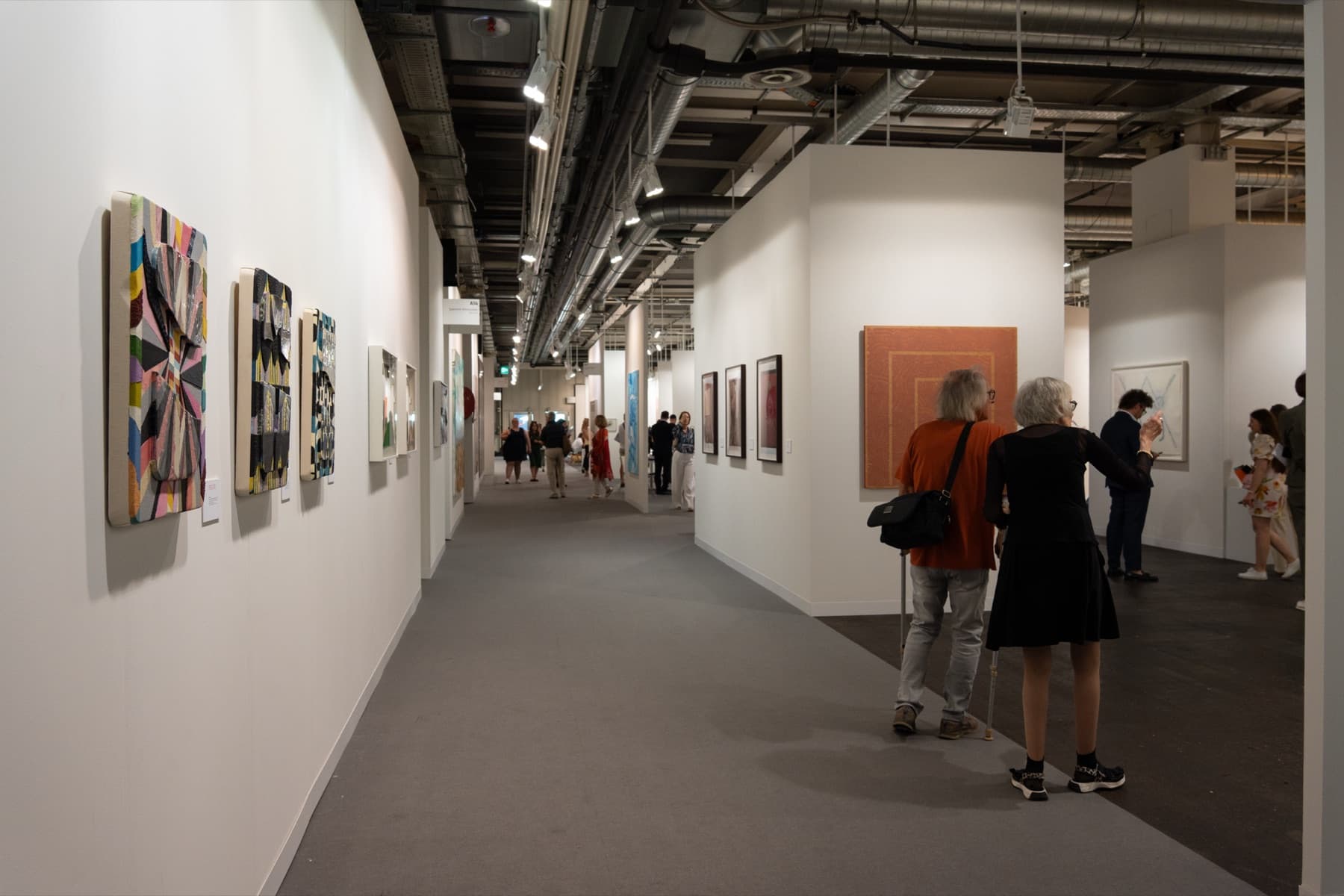
Art Basel closed the 2026 edition of its flagship fair in Basel on June 21, following preview days on June 16 and 17. The edition brought together 290 galleries from 43 countries and territories and drew 90,000 visitors from 103 countries across the week.
Sales were reported as strong from the opening hours through to the final day, and noticeably stronger than in 2025. Hauser & Wirth led with Pablo Picasso's Le peintre et son modèle dans un paysage (1963), offered at an asking price of $35 million. Gerhard Richter's Abstraktes Bild (940-7) (2015) sold for $20 million, and Louise Bourgeois's Les Fleurs (2009) for $2.5 million.
Basel Exclusive did what it was designed to do
The structural story of the edition was Basel Exclusive, introduced for 2026 and developed with participating galleries. More than 190 main-sector galleries agreed to reserve significant works for public unveiling at the Preview opening rather than showing or placing them earlier.
Coordinated scarcity, in other words. If a dealer knows that every other dealer is also holding back their best material for the same hour, the incentive to place quietly in advance collapses, and the preview opening becomes the only moment in the calendar where the whole supply is visible at once.
The reported outcome was a wave of transactions completed within the opening hours. That is exactly what the mechanism was built to produce, and it is the same logic Art Basel has been rolling out across its editions: Avant-Première in Paris in October 2025, and a preview structure in Hong Kong in March that carried nine of the fair's twelve seven-figure sales.
What the top three sales have in common
Picasso 1963. Richter 2015. Bourgeois 2009. One modern master, one postwar name with an established index, one blue-chip late work by an artist with a completed institutional record.
None of it is a bet. All of it is supply-constrained material by artists whose prices have a decade or more of comparables behind them. That is the same signature we read in Miami in December, and the Art Basel and UBS report published three months before this fair gave it a name: a market recovering by 4% in aggregate while the recovery concentrates where the risk is lowest.
For galleries whose program is not blue chip, a $35 million Picasso in Basel is good news about the fair and ambiguous news about the business. Confidence at the top does not automatically flow down. As we found in our reporting on the closures this spring, for parts of the middle market it did not flow down at all.
The scale question
290 galleries and 90,000 visitors from 103 countries is close to the practical ceiling for a fair of this format. Art Basel's growth for the past two years has not come from making Basel bigger. It has come from adding editions (Doha in February), from adding preview tiers that extract more value from the same floor, and from a five-year exclusivity agreement in Hong Kong that protects a regional position rather than expanding one.
That is a mature company's playbook, and it is worth stating plainly: the fair business is now being run for yield per square metre rather than for square metres. Everything Art Basel has introduced since 2025, from Avant-Première to Basel Exclusive to Zero 10, is legible under that frame.
Figures as reported by Art Basel and cross-checked against contemporaneous sales reporting from Artsy and Artlyst. Fair prices are asking prices or gallery-confirmed sales, not audited transactions.