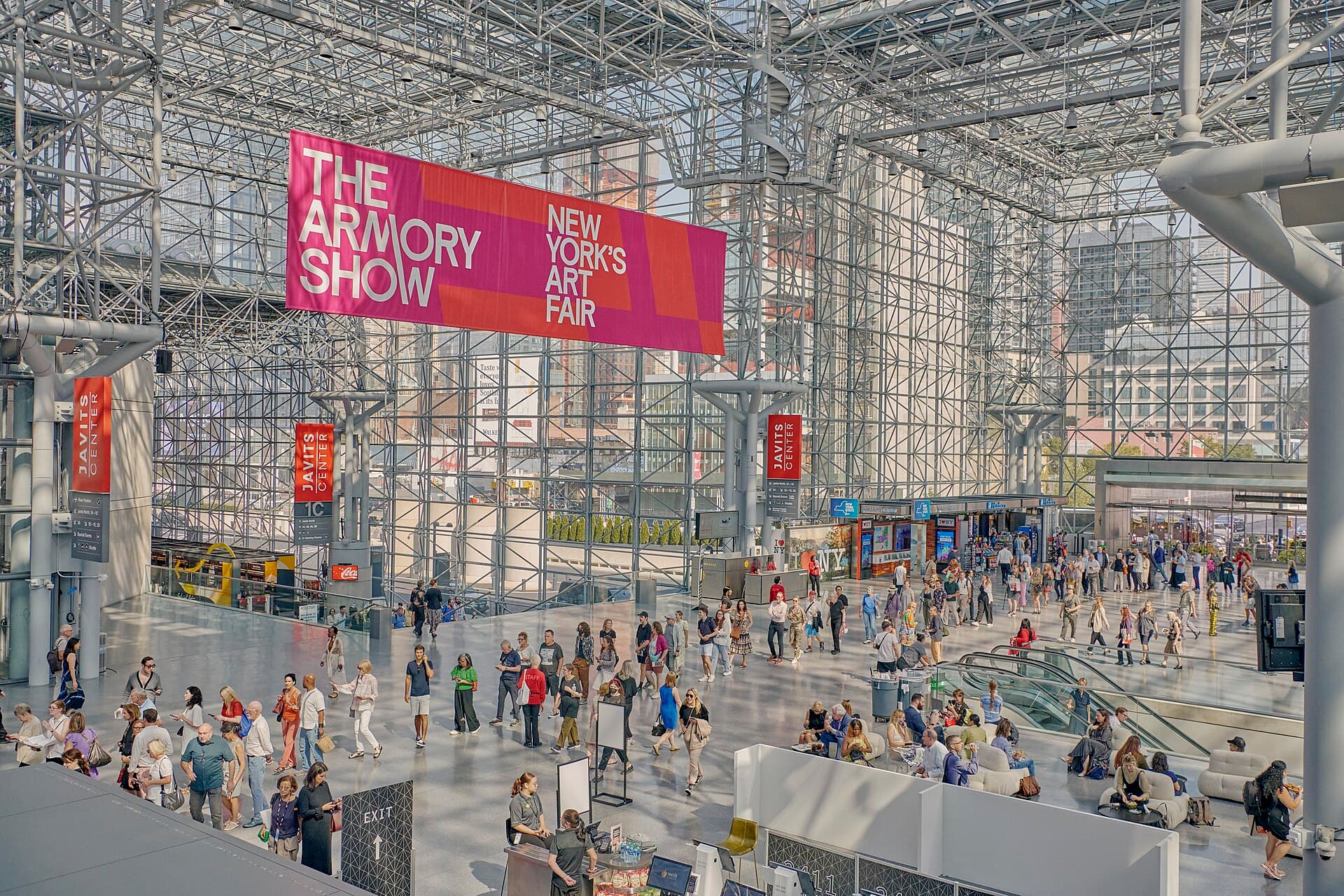
The Armory Show returns to the Javits Center from September 24 to 27, 2026, with roughly 230 galleries from more than 30 countries. The line-up is the largest the fair has fielded in several editions, and the sections have been rebuilt around smaller presentations: Presents grows to around 55 galleries and Solo to about 25 single-artist stands, while the curated Platform and Focus sections are built around artists working across the Caribbean and first-generation North American artists shaped by the Caribbean diaspora.
All of that is the announcement. The decision worth reading is the date.
A fair that moved to stop competing with itself
The Armory has historically opened in the first half of September, anchored to the start of the New York season. The 2026 edition sits more than two weeks later than usual, and the stated reason is a scheduling clash with Frieze Seoul.
Frieze acquired The Armory Show, along with Expo Chicago, in 2023. So the collision being solved here is not between two competitors. It is between two fairs on the same balance sheet, competing for the same collectors, the same shipping windows and the same week of a gallery's travel budget.
That changes what a calendar is. For most of the fair era, dates were a weapon: you booked against a rival to force galleries and collectors to choose, and you took the half of the market that chose you. Once one company owns both fairs, that fight is simply an internal cost. Moving the Armory does not cede ground to anybody. It recovers revenue that the group was previously spending on beating itself.
What New York gains and what it loses
The gain is real. A gallery that wanted Seoul and New York had to pick one, and mid-sized galleries almost always picked the one closer to home. Separating the two lets the same gallery do both, which is exactly the outcome an owner of both fairs wants.
The loss is the anchor. The Armory's early-September slot gave New York a clean opening bell: the fair started the season, the galleries opened their shows around it, and the week read as a single event. September 24 lands in a much busier stretch of the international calendar. It now sits inside Milan Fashion Week, which runs September 22 to 28, and a week ahead of Paris, which means the international press corps that used to move between art and fashion weeks in New York now has to choose a city instead of a taxi.
For a fair whose pitch has always been the Americas meet here, that is a trade: better gallery attendance, thinner incidental attention.
The section rebuild is the more interesting bet
Underneath the date story there is a structural one. Growing Presents to about 55 galleries and Solo to about 25 means a substantial share of the floor is now given to young galleries and to single-artist stands.
Single-artist presentations are the hardest sell on a fair floor and the easiest thing to remember afterwards. A booth with one artist cannot hedge. It either works or it is four days of an expensive wall. Fairs lean on them when they need the floor to be legible rather than merely full, and legibility is what the Armory has lacked against Art Basel's Miami edition and against Frieze in London.
Pair that with Platform and Focus built on Caribbean and Caribbean-diaspora practices, and the fair is making a curatorial claim rather than a commercial one: that the interesting version of "the Americas" is not the New York to Los Angeles axis everyone already books.
What to watch in September
The number that will tell you whether the move worked is not attendance and not sales. It is how many galleries appear at both Frieze Seoul and the Armory this year that could only afford one of them last year. That figure is the entire justification for the date change, and it is the one the fair is least likely to publish.
Dates, gallery counts and section figures as announced by the fair and reported in The Art Newspaper and ARTnews. Ownership per Frieze's 2023 acquisition announcement.