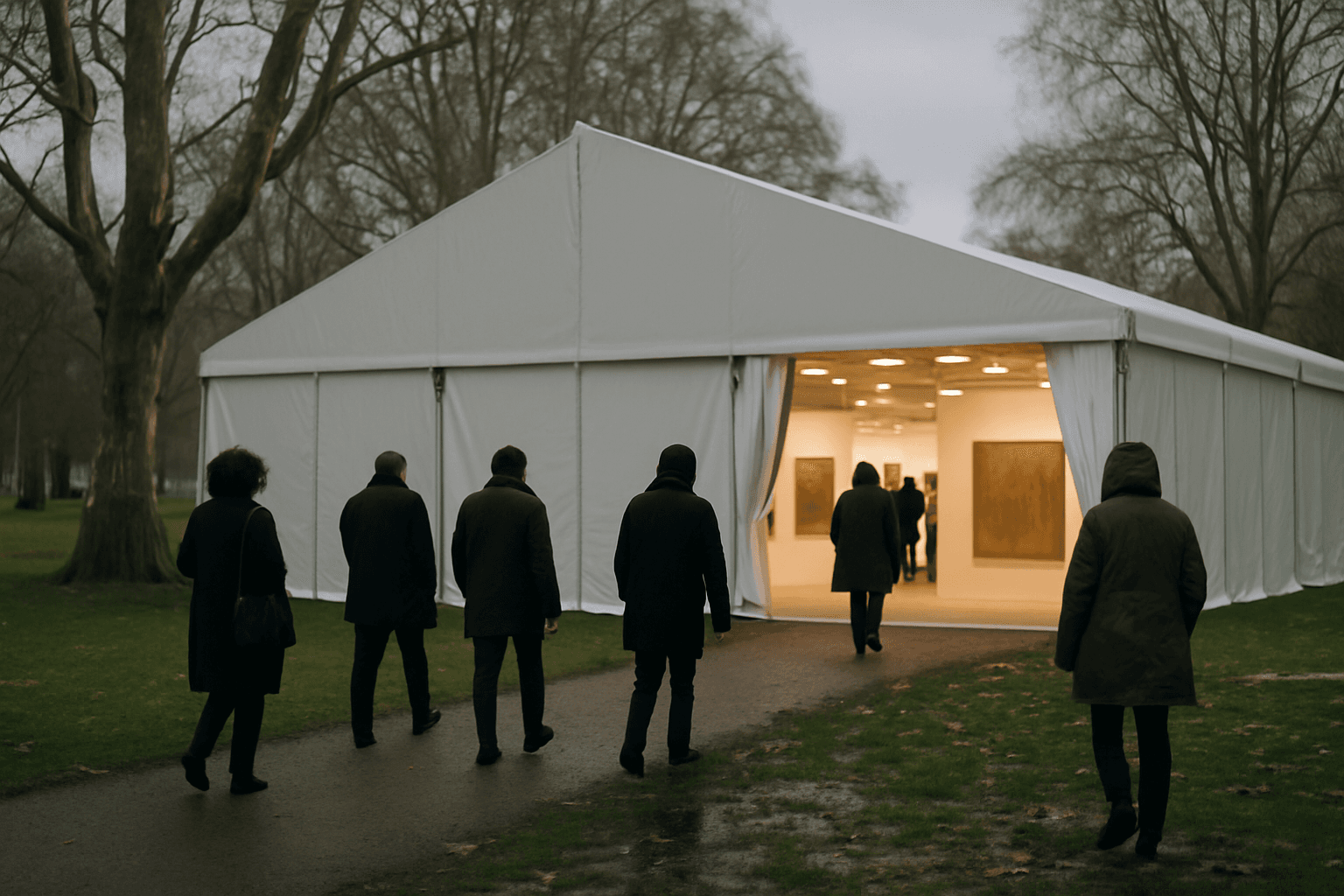
Frieze London and Frieze Masters closed on Sunday, October 19, 2025, having drawn more than 280 exhibitors from over 45 countries across the two tents in Regent's Park and tens of thousands of visitors.
Hauser & Wirth led the reported sales from both fairs with Gabriele Münter's Der blaue Garten (Mein Gartentor) (1909), sold at Frieze Masters for CHF 2.4 million ($3.01 million). Also at Masters: René Magritte's Le domaine enchanté (1953) at $1.6 million and Paul Klee's Befestigter Ort (1929) at €1.45 million ($1.69 million).
The same gallery's top reported sale at Frieze London, the contemporary fair, was Ellen Gallagher's Lips & Paper (1993) at $950,000. Thaddaeus Ropac's leading London placement was Robert Rauschenberg's Polls (1987) at $850,000.
Read the two tents against each other
One dealer, two fairs, same week, same collectors walking between them. At Masters they placed a 1909 Münter for three times what their best contemporary work made.
That gap is the whole story of the 2025 European autumn. Historical and modern material, with settled attributions, published catalogues raisonnés and decades of comparables, cleared prices that contemporary material could not. And note that the strongest contemporary sales were themselves historical by contemporary standards: a 1993 Gallagher, a 1987 Rauschenberg. Not new work.
The Art Basel and UBS report published five months later gave the pattern its aggregate: a market up 4% overall, with the recovery concentrated where risk was lowest.
Frieze Masters is quietly the more important fair
Frieze built its name on the contemporary tent. It launched Masters in 2012 as a complement, aimed at collectors who wanted historical material in the same week.
Thirteen years on, in a year when the trade was rebuilding confidence, Masters is where the money went. That has consequences for how the fair positions itself, for which dealers get the best stands, and for a generation of galleries whose entire proposition is work made in the last five years by artists in the first decade of their careers.
Because here is the uncomfortable arithmetic for those galleries: a collector reallocating from emerging to historical is not pausing, they are leaving the category. Münter died in 1962. Her market is not competing with a young painter for the same wall, it is competing for the same budget, and it wins that competition by offering a settled record instead of a thesis.
What carried into 2026
Two things, both confirmed since.
Dealers reported stronger-than-expected engagement across the week, and that mood held: the fair circuit through 2026 has run consistently better than its 2025 equivalents.
But the tilt toward safety persisted as well. By June, The Art Newspaper's read on the auction season was that blue chip was getting a boost while edgier material stayed in the doldrums, and by summer the middle of the gallery market had started losing names. Frieze 2025 is where that divergence became legible in a single week.
Sales as reported by the galleries and collected by Artsy, ARTnews and Artlyst. Exhibitor counts per Frieze.