Fair economics get discussed constantly and quantified almost never, because the numbers are private and galleries have no interest in publishing what a bad week cost them. The published ranges are still worth putting in one place.
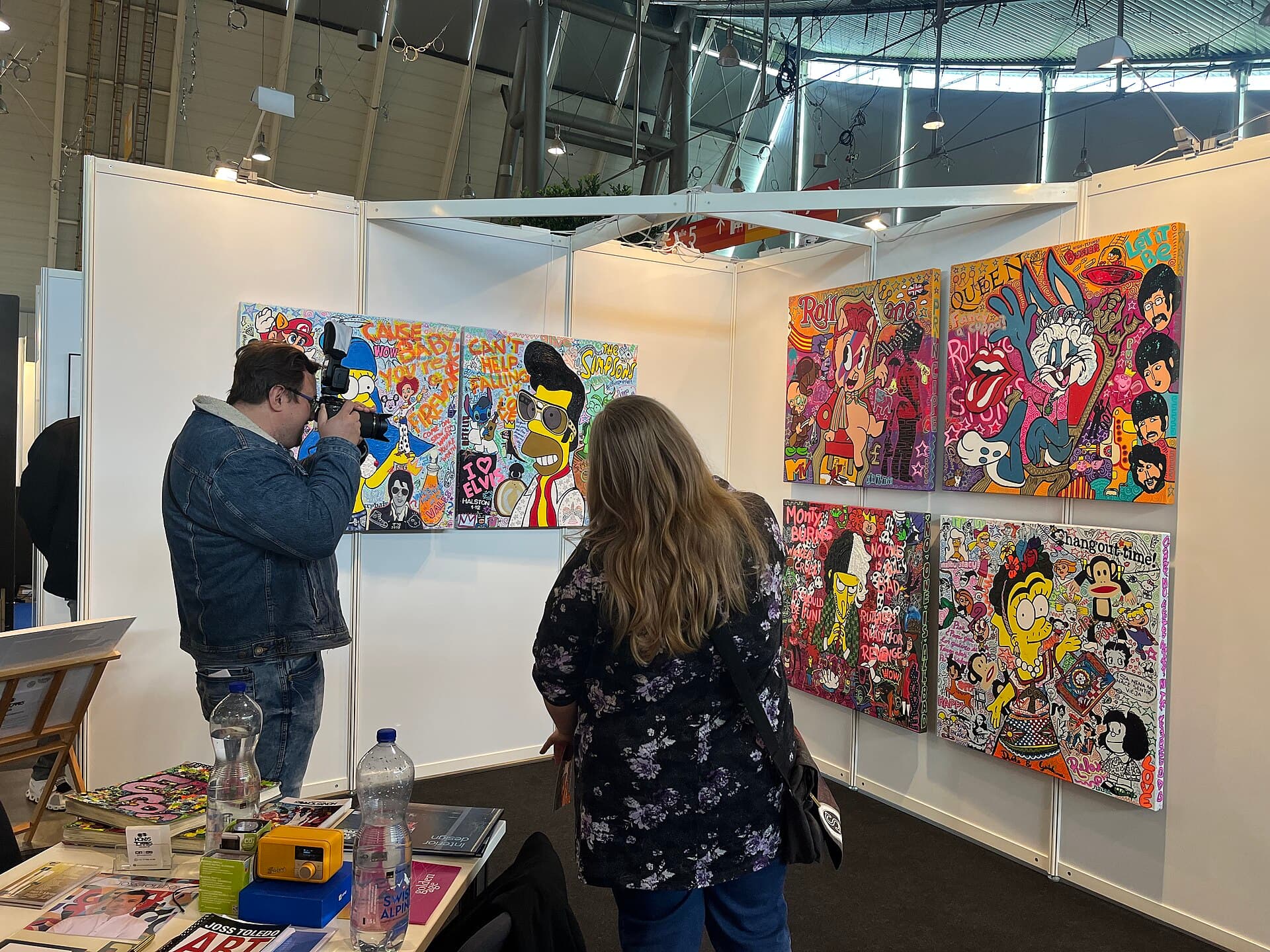
At major fairs, stands run about $76 to $79 per square foot for booths between 100 and 360 square feet, which puts the fee somewhere between $7,000 and $30,000. Larger formats go further: one established fair listed eight booth sizes from under $10,000 to north of $60,000 for its largest. In the prime central aisles, blue-chip galleries pay in the region of $1,000 per square metre. Smaller and regional fairs sit at $300 to $500 per square metre.
The fee is not the cost
Every gallerist will tell you the stand fee is the part they worry about least, and the arithmetic backs them up. Around it sit:
- Shipping work in and out, usually crated, usually insured in transit.
- Insurance for the duration.
- Travel and accommodation for two to four people in a city at its most expensive week.
- Booth build, walls, lighting, furniture.
- Staff time: a fair consumes roughly two weeks of a small gallery's entire capacity, counting preparation and recovery.
A $20,000 stand routinely becomes $50,000 to $70,000 all-in. For a gallery with three or four staff, that is a meaningful share of annual overhead spent on five days.
Why they go anyway
Because the alternative is worse. Fairs are where a gallery meets collectors who will never visit its city, and where an artist's price gets tested against comparable work hanging thirty feet away. Skipping the circuit does not save the money, it removes the mechanism by which the gallery's programme becomes visible outside its postcode.
That is a genuinely bad bargain and everyone in the trade knows it. It persists because it is a coordination problem: no individual gallery can stop attending while its competitors attend, and the fairs know it.
Where this shows up in the numbers
It shows up as attrition. We counted the 2026 fair calendar in exhibitor numbers and found the totals drifting down, and we wrote about two galleries closing in June that were not failing at their actual job.
Put the booth arithmetic beside those two pieces and the mechanism is plain. A structure where the entry fee is fixed and the return is variable does not select for the best programme. It selects for the best-capitalised, and it removes the tier that has capital for four fairs a year but not for six.
This is also why fairs keep adding sections for younger galleries at reduced rates, and why those sections are consistently the most interesting part of any fair floor. It is a subsidy, correctly identified as such by the fairs themselves, for the participants who cannot otherwise afford to be in the room.
What to watch
Whether any major fair publishes its fee schedule. A handful of smaller fairs already do. Transparency on stand pricing would tell you more about the health of the gallery sector than any attendance figure, which is a reasonable explanation for why the large fairs do not offer it.
Booth pricing ranges as compiled by Hyperallergic and REA Fair. Figures vary by fair, section and position; the all-in estimates are the trade's own and are not audited.