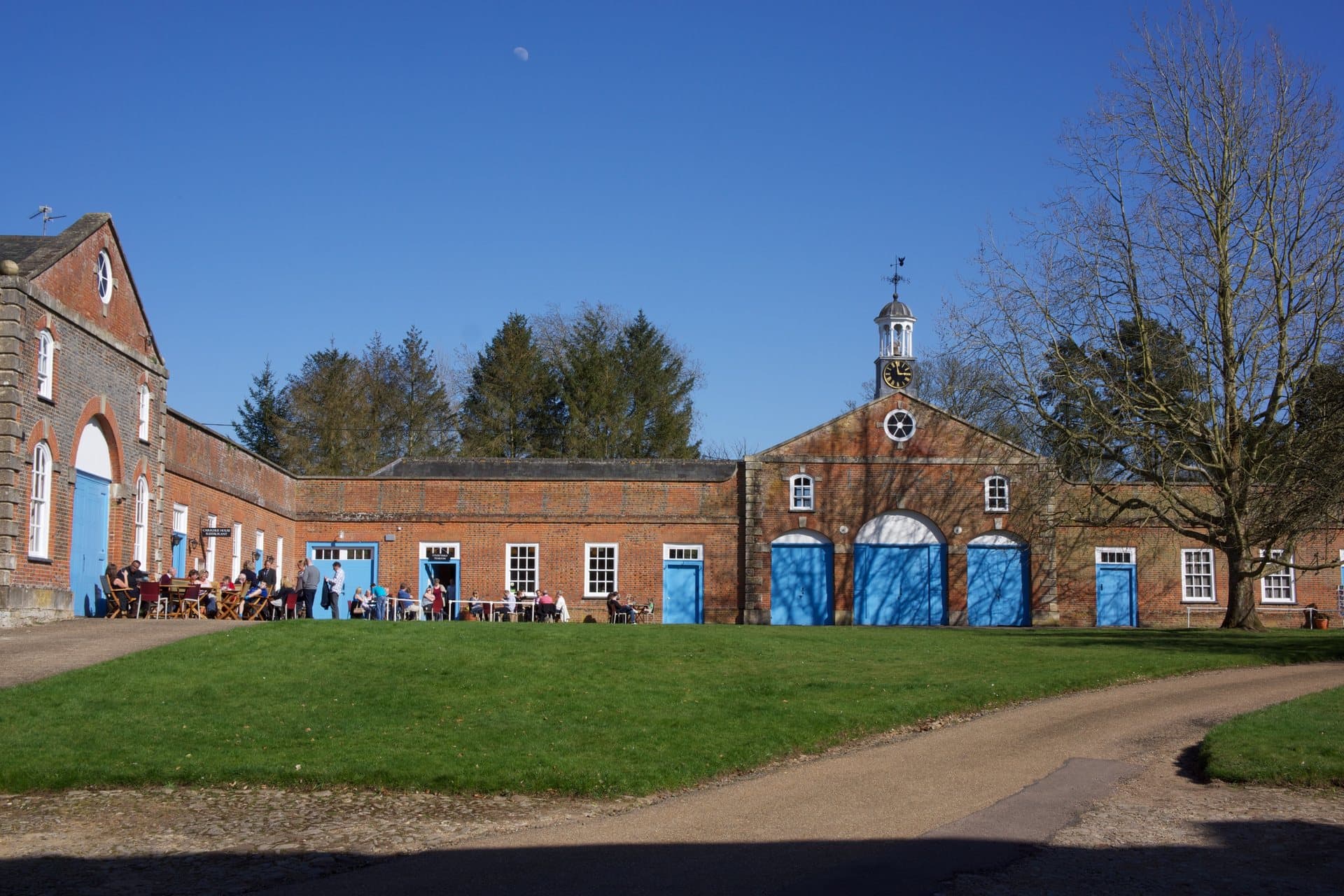
One of the most ambitious gallery exhibitions of the English summer is not in London, and it has three weeks left to run. White Cube at Claydon fills Claydon House, an 18th-century National Trust property in Buckinghamshire, with more than 40 works by over twenty artists, and it closes on September 14.
The list reads like a gallery's evening sale: Tracey Emin, Antony Gormley, Cai Guo-Qiang, Anselm Kiefer, Jeff Wall, Mona Hatoum, Raqib Shaw, Theaster Gates, El Anatsui, Danh Vo and Isamu Noguchi, among others. The works occupy the house's historic rooms and its grounds, and the show opens two gardens that are normally private, the walled Pool Garden and the Florence Nightingale Garden, to visitors for the first time. The project is a collaboration between White Cube, the National Trust and the Verney family, who have lived at Claydon since 1620.
A circuit, not an exception
Claydon is the most visible example of something that has been building for more than a decade. As Art Basel's editors described it in July, what began in the 2010s with a few estates, Chatsworth, Waddesdon and Houghton among them, has become a summer circuit in which commercial galleries, private foundations and historic houses compete to stage museum-quality shows.
This summer's map makes the point on its own. Phyllida Barlow and Daisy Parris at Wolterton Hall in Norfolk. Lynn Chadwick at Houghton Hall. Nancy Holt, Yayoi Kusama and Eva Rothschild at the Goodwood Art Foundation in West Sussex. Catherine Goodman at Boughton House. Veronica Ryan at Mount Stuart on the Isle of Bute. That is a season, with a route. Collectors whose summer used to end with Basel in June now have a reason to spend July and August in the English countryside.
Why a gallery wants a country house
The interesting question is what White Cube gets out of it, because a commercial gallery does not stage a show of this scale for the scenery.
Start with the arithmetic we set out when we looked at booth costs. At a fair, a gallery pays for a few hundred square feet for five days, plus shipping, crating and staff, to show a handful of works to a crowd that is looking at everyone else too. At Claydon, it has an entire house and its gardens for more than three months, a partner with its own membership base, and an audience that has come specifically to see its artists. Admission is £12, and free to National Trust members, so the gallery's program is put in front of a public that no Mayfair space reaches on its own.
Then there is the setting. The exhibition places contemporary work in dialogue with the house's layered history, and White Cube's own description does not shy away from what that history includes: the works, it says, "both celebrate these histories of cultural exchange and comment on the exploitative legacies of colonial extraction on which such opulence was founded." That is a curatorial frame a white-walled gallery cannot supply. The house does the context work, and the art gains weight from it.
What the Trust gets, and what it risks
For the National Trust, a show like this brings contemporary programming, new visitors and national press at a cost it does not carry alone. The Trust has used contemporary art in its houses before. What is new is the scale of the partner: this is one of the world's major commercial galleries, with a program to promote, rather than a public commissioning body.
That is the part worth watching as the circuit grows. A country house that hosts a museum-quality exhibition becomes, for a summer, an extension of a gallery's showroom. There is nothing improper in that, and visitors to Claydon get a museum-scale exhibition for the price of a garden ticket. But the more of these partnerships there are, the more the line between heritage programming and gallery marketing will depend on how openly each one is described.
For now, the model works for everyone involved, and it points in the same direction as the expansion plans of the largest galleries: the big dealers are looking for rooms outside the fair circuit, where they set the terms, and they are finding them in the least expected places.
Exhibition details as published by White Cube and the National Trust. The wider summer program as reported by Art Basel, July 2026.