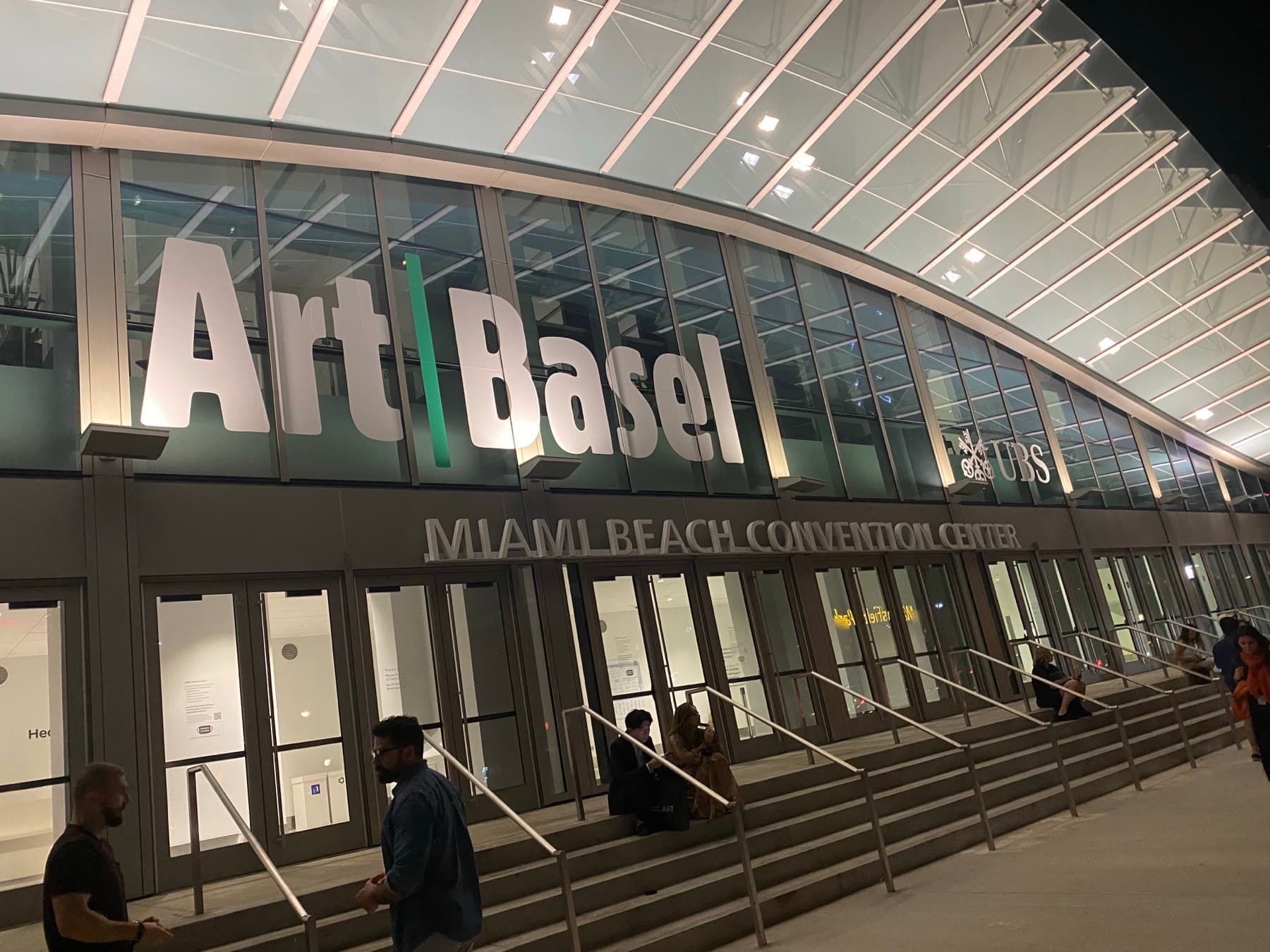
Art Basel Miami Beach closed its 2025 edition on December 7 at the Miami Beach Convention Center with the kind of sales sheet the trade had spent two years waiting for. The fair brought together 283 galleries from 43 countries and territories, including 48 first-time exhibitors, and reported attendance of more than 80,000 across its VIP and public days.
The headline number was an Andy Warhol. Lévy Gorvy Dayan sold Muhammad Ali (1977) for $18 million, the highest reported price of the fair. Underneath it, David Zwirner ran the most visible sequence of the week: a Gerhard Richter at $5.5 million, an Alice Neel painting at $3.3 million, and two of Josef Albers's Homage to the Square canvases at $2.5 million and $2.2 million.
Those four Zwirner placements are worth reading together, because they describe the market better than the Warhol does. Richter, Neel, Albers: postwar and modern names with finite supply and a settled institutional record. Nothing speculative, nothing emerging, nothing that requires a buyer to guess about the next decade.
What the numbers describe
A fair reporting its own success is not a neutral witness, and Art Basel's closing release does what closing releases do. But the December figures were corroborated from outside the tent. CNBC reported strong attendance and sales against the backdrop of a recovering market, and the sales reporting from Artsy and ARTnews tracked the same pattern across the aisles: transactions closing across sectors and price points rather than clustering at the top.
That distinction matters. A fair where only the eight-figure works move is a fair with a liquidity problem dressed up as a trophy sale. Miami 2025 did not read that way. Dealers described placement running from postwar and modern masters through to emerging work, and the November New York auction season had already set up the mood: good results there carried straight into Florida.
Zero 10, and the sector nobody could price
The more consequential thing Art Basel did in Miami was structural. The fair used the 2025 edition to launch Zero 10, a global initiative dedicated to art of the digital era, giving digital and generative work an institutional frame inside the world's most watched contemporary fair rather than in a parallel event down the road.
Beeple Studios sold out editions of Regular Animals. The programming drew in the artists who have carried the generative and crypto-native scene through its post-2022 winter: Tyler Hobbs, Kim Asendorf, Joe Pease, XCOPY. Art Basel's own reporting on the opening put the digital sector alongside the blue-chip sales rather than in a footnote.
The timing is pointed. Digital art's last cycle ended with a collapse in confidence that the trade has been slow to revisit. Putting it on the Miami floor, at the fair that sets the December agenda, is Art Basel deciding the category is worth institutionalizing before the next cycle rather than after it.
The read for 2026
Two things came out of the 2025 edition that will shape how the next one is covered.
The first is that Miami has stopped being the fair where the American market finds out how bad things are. For two years the December edition functioned as a stress test. In 2025 it functioned as a marketplace.
The second is the flight to quality that runs through every line of the sales sheet. Warhol, Richter, Neel, Albers. When collectors return after a correction, they return to names with a settled record and constrained supply. The interesting question for 2026 is not whether the top of the market holds. It is whether the confidence travels down to the galleries showing artists nobody has heard of yet, which is a question the satellite fairs answer more honestly than the main tent does.
We covered that end of the week separately, at NADA and Untitled, where the sub-$20,000 market told its own version of the story.
Sales figures in this piece are as reported by the galleries and the fair organizer, and were cross-checked against contemporaneous reporting from Artsy, ARTnews, Artlyst and CNBC. Reported prices at art fairs are asking prices or gallery-confirmed sales, not independently audited transactions.