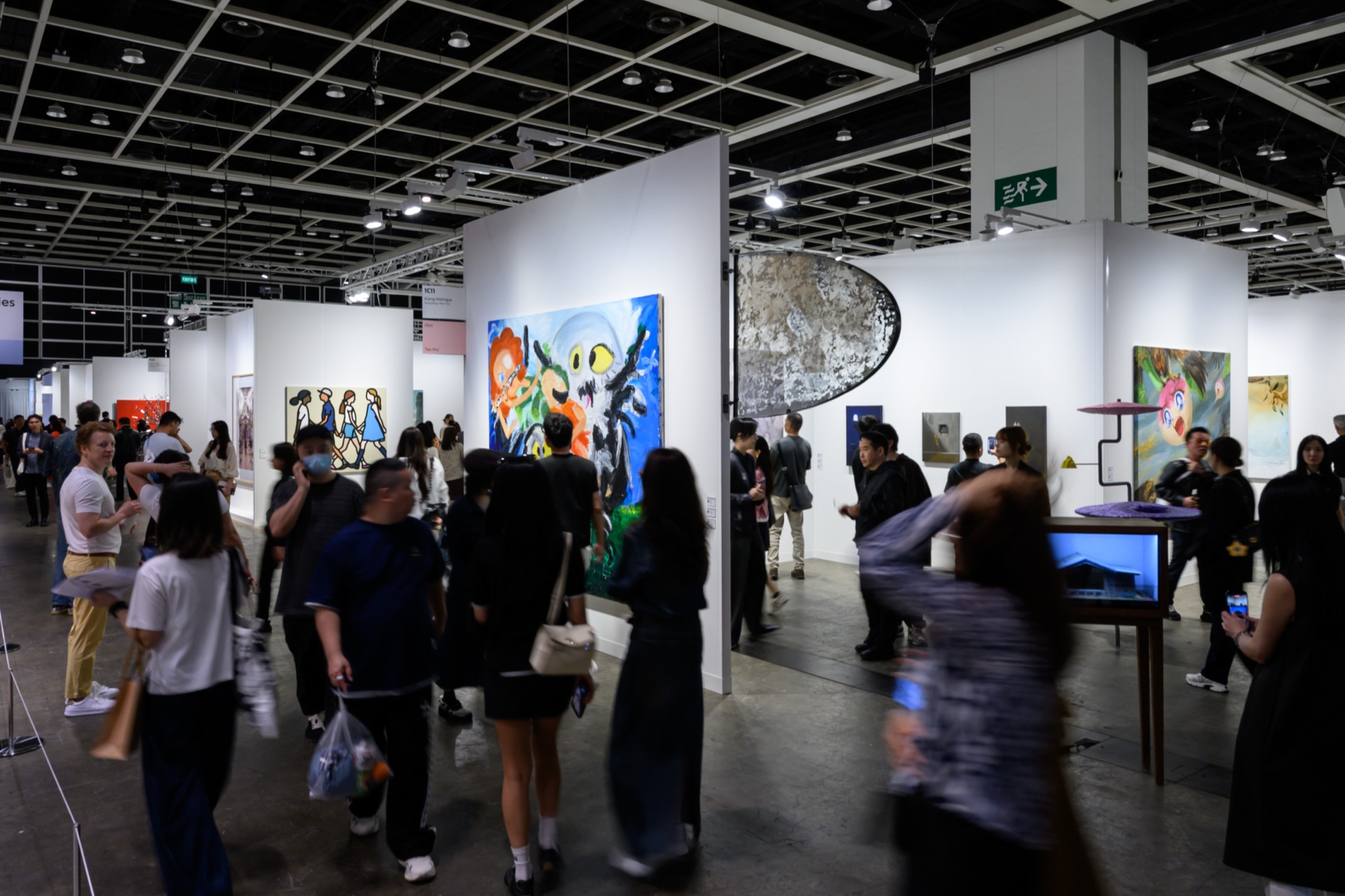
Art Basel published the gallery list for its next Hong Kong edition on November 23, and the first number to read is the one the release does not compare. Art Basel Hong Kong 2027 will bring together 232 exhibitors from more than 40 countries and territories at the Hong Kong Convention and Exhibition Centre, from March 25 to 27, 2027, with Preview Days on March 23 and 24. In March 2026 the fair had 240 galleries from 41 countries and territories. Eight fewer booths is not a crisis. It is, after a deliberately smaller Miami Beach and a Doha edition that lost around 40% of its first cohort, the third Art Basel list in two months that comes in tighter than the one before it.
The other comparisons run the same way. 31 first-time exhibitors, against 32 last year. 27 galleries with spaces in Hong Kong, against 29. None of it is dramatic, and all of it points in one direction: a fair that is no longer growing by addition and has started editing.
The third floor is the real announcement
The structural change is the floor plan. Discoveries, Insights, Echoes and Zero 10 will move together to Level 3 of the HKCEC, which Art Basel says will give the special sectors "greater space and visibility" and bring practices "across generations, geographies, and mediums into closer dialogue."
Read it alongside Miami. In December the group is breaking up its blue-chip aisle so that collectors have to walk past smaller programs on the way to the big ones. In Hong Kong it is doing almost the opposite: gathering the emerging, the historical and the digital into one level of their own. Both decisions answer the same problem, which we described after the 2026 edition, when nine of the fair's twelve reported seven-figure sales closed during the previews. If the money is spent in the first hours on the main floor, the sectors that need time need a place where time is spent.
A floor of their own can be that place. It can also be a mezzanine that the preview-day collector never climbs to. Art Basel has bet on the first reading, and it is a reasonable bet in a building where the escalators already sort the crowd. Whether it works will show in a number the fair does not usually publish: sales in the special sectors before the public days begin.
Who came in
The main sector, Galleries, holds 171 exhibitors, with 13 taking part in it for the first time. The newcomers Art Basel chose to name are Western, and mostly established: Galerie Nordenhake with a Latin American focus (Naufus Ramírez-Figueroa, Jerónimo Rüedi, Raúl Rueda), Yares Art with Abstract Expressionism and Color Field (Frankenthaler, Hofmann, Louis, Mitchell, Motherwell, Noland), Matthew Brown, VeneKlasen pairing Issy Wood and Sanya Kantarovsky with Polke and James Lee Byars, and Emalin with Karol Palczak's Asian debut. Vin Gallery from Ho Chi Minh City and Shanghai graduates from Discoveries to Galleries.
The most interesting entry is Richard Saltoun Gallery, which shows Li Yuan-chia and Rosa Lee, two Chinese-diaspora artists who settled in Britain and built abstraction out of calligraphy. Saltoun is among the galleries not returning to Miami Beach next month. Seeing it arrive in Hong Kong with a presentation built precisely for this audience is a reminder that the circuit is now something galleries choose from, not something they subscribe to.
Five galleries return after a hiatus, and this is the stronger list: Marian Goodman (Tony Cragg, Gabriel Orozco, Pierre Huyghe), Goodman Gallery (Ghada Amer, William Kentridge, Kapwani Kiwanga, Yinka Shonibare, Carrie Mae Weems), Vadehra Art Gallery from New Delhi (Anju Dodiya, N.S. Harsha, Shilpa Gupta), Alfonso Artiaco from Naples, and Galerie Vazieux, moving up from Insights. A New Delhi gallery and a Johannesburg one coming back to Hong Kong is a better sign for the fair than any Western debut, because it says the fair still works as a crossing point and not only as a market for China.
The regional anchors are where they were. 32 galleries come from Mainland China (BANK, Beijing Commune, Magician Space, Vitamin Creative Space among them), 20 from Japan, 16 from South Korea (Arario, Gallery Baton, Kukje, PKM) and 8 from Taiwan. Hong Kong's own scene, Blindspot, Empty Gallery, Kiang Malingue, Rossi & Rossi, holds its 27 places, two fewer than in March. After an autumn auction season that tested how deep the local buyer really is, we would watch those two missing local booths more closely than the 31 new ones.
Where the list is braver
The special sectors carry the risk, and they carry it well.
Insights, with 18 projects on artists from Asia and the Asia-Pacific region, has the clearest thesis of the edition: overlooked modernisms, and women in particular. Mizoe Art Gallery shows Mitsuko Tabe, of the Kyushu-ha collective, who later co-founded an exhibition for women working outside a male-dominated scene. Lucie Chang Fine Arts brings a retrospective of the late Korean artist Ro Eun Nim. PTT Space gives the late Hoo Mojong her first solo fair presentation, and Grosvenor Gallery opens a chapter of Sri Lankan modernism with George Claessen and early Senaka Senanayake. This is what a fair in Asia can do that Basel and Paris cannot do as convincingly: rewrite the canon from the floor, booth by booth, with works that are still priced below their history.
Discoveries has 25 exhibitors, 14 of them new to the sector, and two presentations that will travel well beyond the fair: Arcadia Missa with new large triptych drawings by Nnena Kalu, whom Art Basel describes as the 2025 Turner Prize winner and who is shown in Asia for the first time, and Proyectos Ultravioleta with hand-spun textiles by Silät, a collective of more than 100 Wichí women from Salta, Argentina. Bombon from Barcelona brings Eva Fàbregas' inflatable, biomorphic sculpture, the kind of work that only makes sense if the booth around it has room to breathe. That is, presumably, what Level 3 is for.
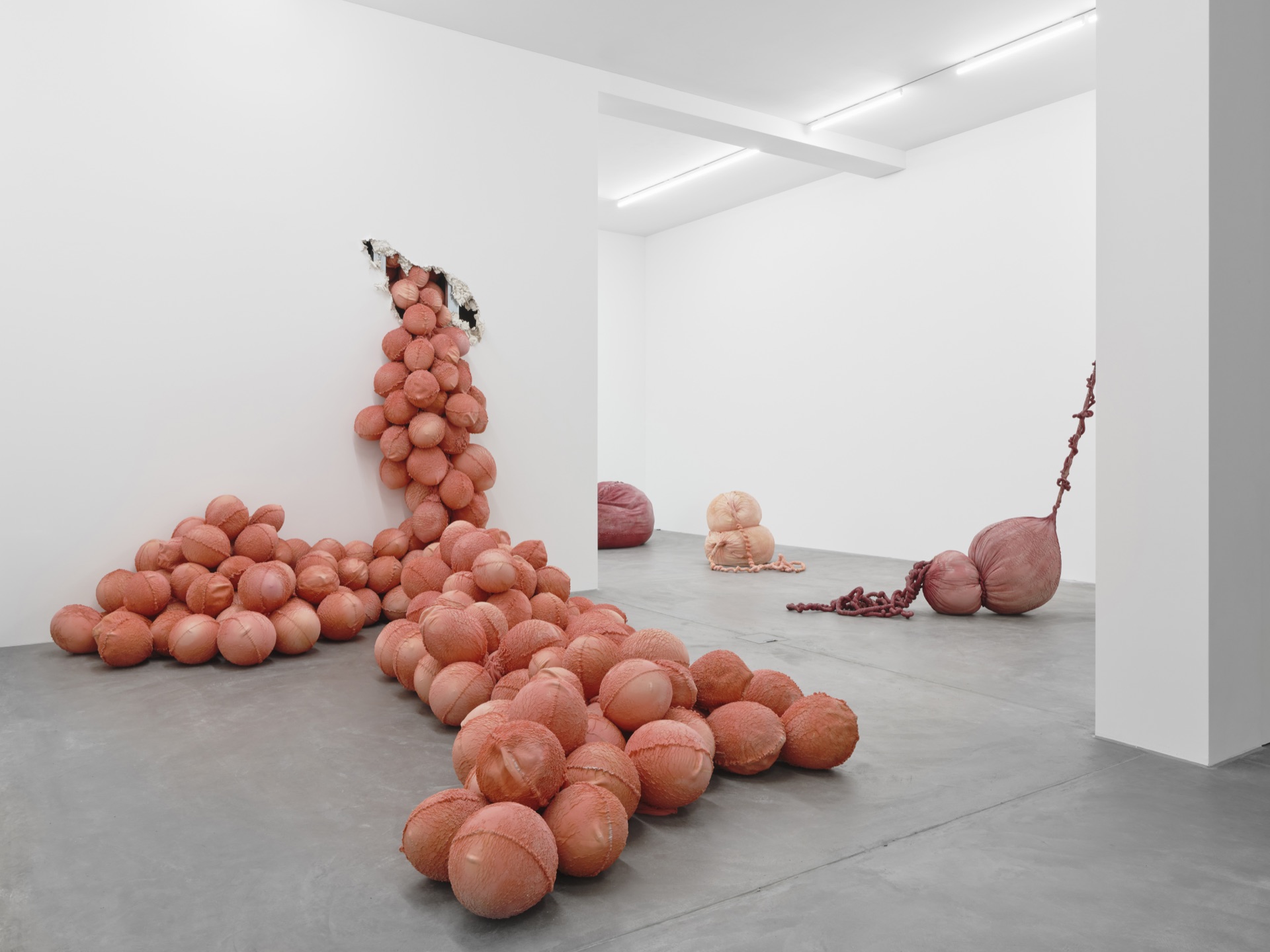
Echoes, the sector for work made in the past five years, returns after its 2026 debut. The headline summary says 18 galleries; the full release clarifies that they share 15 booths, with pairings such as Ginny on Frederick and sans titre showing Rebecca Ackroyd, Hamish Pearch and Agnes Scherer. Shared booths are a sensible way to make a costly fair possible for younger programs, and a small sign of how expensive the main floor has become.
The curators, and Zero 10
The curatorial team mostly stays. Mami Kataoka again leads Encounters with Isabella Tam, Alia Swastika and Hirokazu Tokuyama, and Ellen Pau returns to the Film program. The change is at Zero 10, the group's digital-art platform, now curated by Sunny Cheung, formerly Curator of Design and Architecture at M+, with Eli Scheinman as co-curator. An institutional curator from Hong Kong's own museum is the right appointment for a program that still has to prove it belongs on an art fair's floor rather than at a tech conference. Placing it on Level 3, next to Insights and its modernist women, is either a provocation or an accident of square metres. We hope it is the first.
Director Angelle Siyang-Le frames the edition as "a reimagined visitor journey designed to foster discovery and deeper engagement." The release says nothing about prices, nothing about the preview tiers, and nothing about the sales structure that dominated last March. That silence is normal for a line-up announcement. It is also where the real story of the edition will be.
A shorter weekend
One detail is not in any press bullet. In 2026 the public days ran from Friday to Sunday. In 2027 they run from Thursday, March 25, to Saturday, March 27, with the previews on Tuesday and Wednesday. Easter Sunday falls on March 28, 2027, which puts Good Friday, a public holiday in Hong Kong, in the middle of the fair and ends the run on Holy Saturday. A holiday Friday can fill the halls. It can also empty the city of the collectors who leave for the long weekend. After Paris lost its public weekend and barely registered it in the sales report, Hong Kong's calendar will tell us again how much the public days still matter to the preview-day hierarchy.
We will be covering the fair in March. Three questions until then: whether Level 3 sells during the previews or waits for the holiday crowd; whether the returning South Asian and African programs find buyers or only visitors; and whether a smaller list produces a smaller sales report, or simply a more concentrated one.
Exhibitor and sector figures, newcomers and returning galleries, sector highlights, the Level 3 reconfiguration, curatorial appointments, dates and Angelle Siyang-Le's remarks from Art Basel's announcement of November 23, 2026, including its full exhibitor list. 2026 figures (240 galleries, 41 countries and territories, 32 first-time exhibitors, 29 galleries with Hong Kong spaces) from Art Basel's 2026 line-up announcement. 2026 visitor and seven-figure sales figures from Art Basel's closing report and The Art Newspaper. Press images courtesy of Art Basel. This is desk coverage ahead of the fair.